
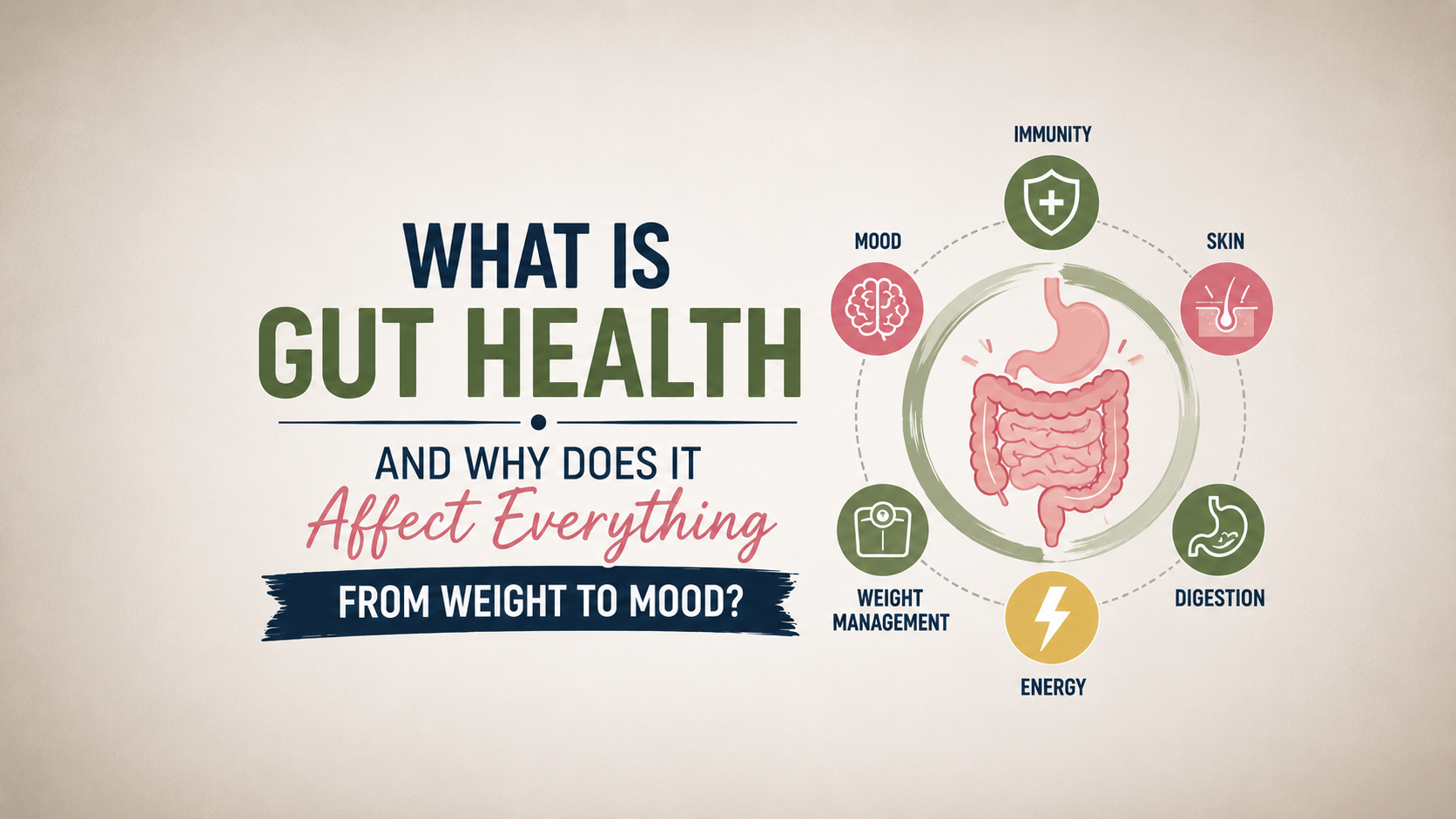
What Is Gut Health and Why Does It Affect Everything From Weight to Mood?
Trust Your Gut Is More Scientific Than You Think
You have probably heard someone say "trust your gut." It turns out that phrase is more scientifically accurate than most people realise.
Your gut is not just responsible for digesting food. It is a complex, living ecosystem that influences your weight, your immune system, your hormones, your energy levels, and yes, your mood. Scientists now call it the "second brain," and for good reason.
In India, where digestive issues like bloating, acidity, and constipation are extremely common, understanding gut health is not just a wellness trend. It is genuinely important information that most people have never been given clearly.
What Is the Gut Microbiome?
Your gut contains trillions of microorganisms including bacteria, fungi, viruses, and other microbes. Together, these are called the gut microbiome.
This is not just a passive population of tiny organisms sitting in your intestines. Your gut microbiome is actively involved in breaking down food and extracting nutrients, producing certain vitamins including B12 and vitamin K, regulating immune responses, producing neurotransmitters that affect your mood and brain, and influencing how your body stores fat and uses energy.
A healthy gut has a large diversity of beneficial microbes. An unhealthy gut has too few good bacteria and often an overgrowth of harmful ones, a state called dysbiosis.
The ratio of good to bad bacteria in your gut is shaped by everything you eat, how you sleep, how much you exercise, your stress levels, the medications you take, and even whether you were breastfed as a baby.
How the Gut Affects More Than Just Digestion
Most people think of gut health as purely a digestive matter. Bloating? Gut problem. Constipation? Gut problem. But the gut's influence extends far beyond your digestive tract.
Gut Health and Energy
Your gut bacteria help extract energy from the food you eat. When your microbiome is imbalanced, this process becomes inefficient. You may absorb fewer nutrients, experience energy crashes after meals, or feel chronically fatigued regardless of how much you sleep.
Gut Health and Skin
The gut-skin axis is a well-documented connection. Conditions like acne, eczema, rosacea, and psoriasis are all linked to gut dysbiosis. When the gut lining becomes inflamed, inflammatory signals spread systemically, often showing up on the skin.
Gut Health and Immunity
Approximately 70 to 80 percent of your immune system lives in your gut. The gut microbiome trains your immune system to recognise threats and regulate inflammatory responses. When gut bacteria are imbalanced, your immune system becomes either underactive (missing real threats) or overactive (attacking harmless substances, which is the basis of allergies and autoimmune conditions).
The Gut-Brain Connection
This is perhaps the most surprising and important piece of gut health science.
Your gut and brain communicate constantly through the vagus nerve, a long nerve that runs from your brainstem all the way down to your gut. This is called the gut-brain axis.
When your gut microbiome is disrupted, serotonin production can drop. This is one of the reasons gut dysbiosis is consistently linked to depression and anxiety, brain fog and difficulty concentrating, mood swings and irritability, and poor sleep quality.
Research is increasingly showing that treating gut health can meaningfully improve mental health outcomes. This does not mean gut health is the only factor in mental health, but it is a significant and frequently overlooked one. For a related look at how hormones and the brain interact, see PMOS and the hormonal symptoms nobody talks about.
Gut Health and Weight Loss
If you have been eating well and exercising but struggling to lose weight, your gut health may be part of the explanation.
The Microbiome-Metabolism Link
Studies comparing the gut bacteria of lean and overweight people consistently find significant differences in their microbiome composition. People carrying excess weight tend to have fewer Bacteroidetes bacteria and more Firmicutes bacteria, a balance associated with extracting more calories from the same amount of food.
In practical terms: two people can eat identical meals and absorb different amounts of energy from them depending on their gut microbiome.
Gut Bacteria and Appetite Hormones
Certain gut bacteria influence the production of hormones like ghrelin (hunger) and leptin (fullness). An imbalanced microbiome can disrupt these signals, leading to feeling hungry even after eating enough, strong cravings for sugar and processed foods, and difficulty feeling satisfied from nutritious meals.
Important: Leaky gut, or increased intestinal permeability, allows bacterial toxins called lipopolysaccharides to enter the bloodstream. This triggers systemic inflammation, which is directly linked to insulin resistance and abdominal fat storage. Gut health is not separate from weight management. It is a core part of it.
Gut Health and Your Immune System
As mentioned, 70 to 80 percent of your immune system is located in your gut, specifically in gut-associated lymphoid tissue.
Your gut bacteria play an active role in training immune cells to distinguish harmful pathogens from harmless substances, producing antimicrobial compounds that fight infections, regulating inflammatory responses to prevent them from becoming chronic, and maintaining the gut lining as a physical barrier against pathogens.
When the gut microbiome is disrupted, immune dysregulation follows. This is why people with poor gut health tend to get sick more often, take longer to recover, and have higher rates of chronic inflammatory conditions.
What Damages Your Gut Health
Understanding what harms your gut is just as important as knowing what helps it.
Antibiotics: Sometimes necessary, but among the most disruptive forces for the gut microbiome. They do not selectively kill only harmful bacteria. They wipe out large populations of beneficial bacteria as well, and recovery can take months or years without deliberate gut-restoration efforts.
Ultra-processed foods: Packaged snacks, instant noodles, commercial biscuits, and most fast food contain additives, emulsifiers, and preservatives that research shows actively harm gut bacteria diversity.
Sugar and refined carbohydrates: Harmful gut bacteria feed on sugar and refined carbs. A diet high in these foods selectively promotes the growth of dysbiotic bacteria while starving the beneficial ones.
Chronic stress: Stress directly affects gut bacteria through the gut-brain axis. It increases intestinal permeability, changes microbiome composition, and triggers inflammatory responses in the gut lining, which is why many people experience digestive issues during periods of high stress.
Poor sleep: Sleep deprivation disrupts the circadian rhythms of gut bacteria. Even short periods of poor sleep can meaningfully shift microbiome composition in ways that promote inflammation and metabolic dysfunction.
Sedentary lifestyle: Regular physical activity is one of the most powerful tools for improving gut microbiome diversity. People who exercise regularly consistently have more diverse, healthier gut microbiomes than sedentary individuals.
How to Improve Your Gut Health
Eat More Fibre
Dietary fibre is the primary food source for beneficial gut bacteria. Most Indians are chronically under-eating fibre.
- Dal and legumes: Rajma, chana, moong, and masoor provide both fibre and protein for gut bacteria
- Whole grains: Bajra, jowar, oats, and brown rice are far better choices than refined alternatives
- Vegetables and fruits: Broccoli, onion, garlic, green banana, guava, papaya, and apple with skin are excellent fibre sources
- Nuts and seeds: Add variety and additional fibre to your daily intake
Aim for 25 to 30 grams of dietary fibre per day.
Eat Fermented Foods
Fermented foods contain live beneficial bacteria, or probiotics, that directly add good microbes to your gut. The traditional Indian diet is actually rich in fermented foods: curd (dahi) is one of the best probiotic foods available in India, alongside idli and dosa batter, kanji, homemade pickle in limited amounts, and buttermilk (chaas).
Aim to include at least one fermented food per day.
Reduce Ultra-Processed Foods
Replacing packaged snacks, commercial biscuits, and processed foods with whole foods is one of the most impactful changes you can make for gut health. For a deeper look at why structured nutrition matters, read why diet plans fail without fitness guidance.
Manage Stress Actively
Yoga, meditation, regular walks, and adequate sleep all reduce the stress impact on your gut microbiome. Even 10 minutes of daily deep breathing has been shown to improve gut function.
Exercise Regularly
Research shows that regular aerobic exercise directly increases gut microbiome diversity. People who exercise have more beneficial bacteria and better gut barrier integrity than sedentary individuals.
Eat a Wide Variety of Plant Foods
Gut microbiome diversity is strongly linked to the diversity of plant foods you eat. A simple rule: aim to eat at least 30 different plant foods per week, including all vegetables, fruits, whole grains, legumes, nuts, seeds, and herbs.
Why fitnoa Works for Improving Your Gut Health
Since regular physical activity is one of the most powerful tools for improving gut microbiome diversity, every session you complete with fitnoa is also a direct investment in your gut health.
- Varied live workouts across yoga, cardio, strength training, and bodyweight exercises, all of which directly support a more diverse and healthier gut microbiome
- AI posture tracking with a live trainer: For gut health specifically, this means performing core-engaging exercises and yoga poses with correct technique, maximising their effectiveness for both fitness results and internal organ health
- Detailed post-session reports that help you track consistency over time, and consistency is the key factor in exercise-driven gut microbiome improvement
- Complete privacy: Only you and your trainer are visible during sessions, helping you build the kind of consistent, stress-free exercise habit that benefits gut health most
- Personalised nutrition plans that include fibre targets, fermented food recommendations, and anti-inflammatory eating patterns built around your individual goals
- One accessible price that combines live fitness coaching and personalised nutrition guidance, since having both exercise and dietary support in a single integrated programme makes a far bigger difference for gut health than addressing either one alone
Key Takeaways
- Your gut microbiome contains trillions of microorganisms that influence weight, mood, immunity, energy, and hormones
- Gut health affects far more than digestion. It directly impacts your brain chemistry, immune system, skin, and metabolic health
- Your gut produces 90 to 95 percent of your serotonin, making it central to mood regulation
- Poor gut health contributes to weight gain, inflammation, and difficulty losing fat
- Ultra-processed foods, excess sugar, chronic stress, antibiotics, and poor sleep all damage the gut microbiome
- Fermented foods (curd, idli, chaas), dietary fibre, regular exercise, and stress management are the most effective ways to improve gut health
- Eating 30 or more different plant foods per week is one of the best things you can do for gut microbiome diversity
Related reads you may find helpful
Frequently asked questions
Everything you need to know
Support Your Gut From the Inside Out
Gut health improves through the same combination of consistent movement and the right nutrition that drives every other part of your wellbeing. fitnoa pairs live expert fitness coaching with a personalised nutrition plan built around fibre, fermented foods, and your specific health goals. Try your first class completely free.