
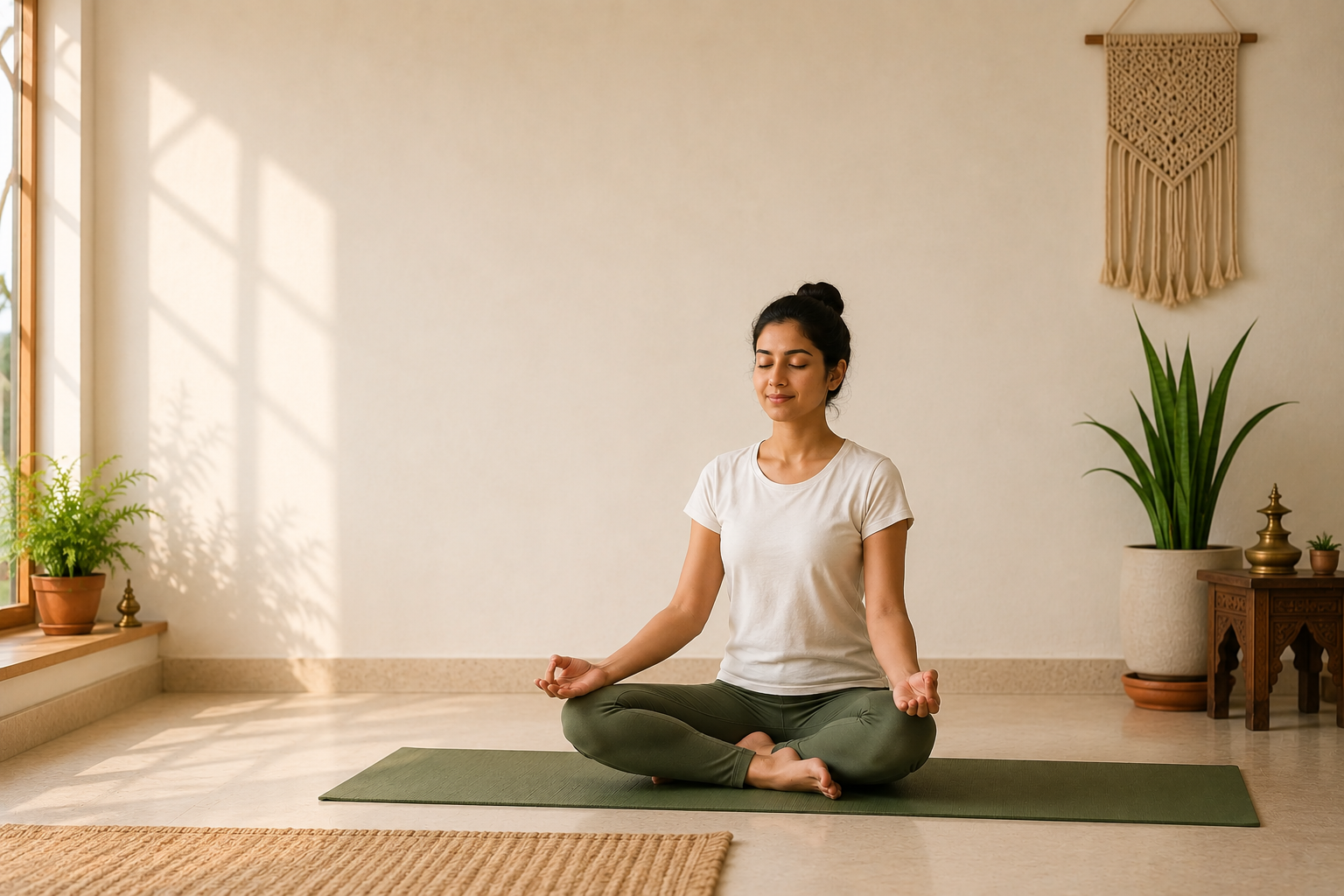
Morning Yoga Routine for Beginners at Home in India (10 Minutes, No Experience Needed)
Most people who want to start morning yoga never do because they think they need a 45-minute class, a perfect mat, or flexibility they haven't built yet.
Here's the truth: 10 minutes of yoga every morning, done consistently, will change how your body feels, how your mind starts the day, and over time how you look.
This guide gives you a real 10-minute morning yoga routine built specifically for Indian beginners at home. No props required. No prior experience needed. If you've been meaning to start, today is the day.
Why Morning Yoga Works (Especially for the Indian Lifestyle)
Mornings in India are often rushed, chai on the stove, kids to get ready, traffic to beat. A 10-minute yoga routine fits into your morning rather than replacing it.
- Wakes your body gently: Muscles and joints are stiff after 6–8 hours of sleep. Morning yoga moves synovial fluid through your joints, reducing that familiar lower back, hip, and shoulder ache.
- Lowers cortisol: Cortisol peaks in the morning. Even 10 minutes of gentle stretching and breathwork has been shown to reduce stress hormone levels and set a calmer tone for the day.
- Improves digestion: Twisting and forward-folding postures stimulate the digestive system, particularly helpful for bloating, constipation, or an irregular stomach.
- Builds habits faster: Morning habits attach to existing anchors like waking up and brushing teeth, making them more consistent than evening routines that fatigue and social plans disrupt.
Important: Practice on an empty or light stomach. Traditional yoga recommends at least 2 hours after a meal. Early morning is ideal, water is fine, chai is fine, but skip a heavy breakfast before your session.
Your 10-Minute Morning Yoga Routine
This sequence is designed for complete beginners. Each pose is safe, requires no prior flexibility, and can be done on a yoga mat, carpet, or any non-slippery surface.
Total time: 10 minutes | Equipment: mat or soft surface, comfortable clothes | Best time: first thing after waking
Pose 1 – Balasana (Child's Pose) — 1.5 Minutes
Kneel with big toes touching and knees apart. Lower your hips toward your heels and stretch your arms forward, resting your forehead on the mat. Breathe slowly, in and out through the nose.
This gently decompresses the spine after sleep and signals the nervous system to shift from restful to gently active. Don't force your hips to your heels, let gravity do the work. If they don't reach, place a folded blanket or pillow between your thighs and calves.
Pose 2 – Marjaryasana-Bitilasana (Cat-Cow) — 1.5 Minutes
Come onto all fours, hands under shoulders, knees under hips. On an inhale, drop your belly and lift your chest (Cow). On an exhale, round your spine upward and tuck your chin (Cat). Repeat 8–10 times, moving slowly with your breath.
Cat-Cow is the most effective 2-minute spinal warm-up, it mobilises every vertebra and syncs breath with movement. Move slowly and pause at each end position. The benefit comes from the breath, not the speed.
Pose 3 – Adho Mukha Svanasana (Downward Dog) — 1.5 Minutes
From all fours, tuck your toes and lift your hips toward the ceiling into an inverted V-shape. Press firmly through all fingers, and lengthen your spine. Bend your knees if your hamstrings are tight, this is completely normal for beginners. A long spine with bent knees is always better than straight legs with a rounded back.
Pose 4 – Ashwa Sanchalanasana (Low Lunge) — 1.5 Minutes (45 seconds each side)
From Downward Dog, step your right foot forward between your hands. Lower your left knee to the floor, square your hips forward, and gently sink them down. Raise your arms overhead if comfortable, or keep hands on the floor. Hold for 3–4 breaths, then switch sides.
This targets the hip flexors, the area that becomes chronically tight from sitting. Tight hip flexors contribute to lower back pain, poor posture, and digestive discomfort. Keep the front knee directly over the ankle; don't let it collapse inward.
Pose 5 – Uttanasana (Standing Forward Fold) — 1 Minute
Stand with feet hip-width apart. Exhale and fold forward from the hips, letting your head and arms hang. Bend your knees as much as needed. The goal is length in the spine, not touching the floor. Hold for 5–6 slow breaths. Don't bounce; hold still and let the fold deepen naturally over weeks.
Pose 6 – Tadasana into Surya Namaskar (3 Slow Rounds) — 3 Minutes
Stand tall with feet together and arms at your sides. Take one full breath, then move through 3 gentle rounds of Sun Salutation at a slow pace:
- Raise arms overhead (inhale)
- Forward fold (exhale)
- Step back to plank, lower down gently (exhale)
- Cobra or Upward Dog (inhale)
- Downward Dog (exhale)
- Step forward, forward fold (exhale)
- Rise up, arms overhead (inhale)
- Hands to heart (exhale)
Surya Namaskar works every major muscle group, links breath to movement, and builds internal heat. Three slow rounds provide a complete full-body warm-up. Slow and intentional always beats fast and sloppy, especially in the morning.
Closing – Savasana (Corpse Pose) — 1 Minute
Lie flat on your back, legs apart, arms away from your body with palms facing up. Close your eyes and breathe naturally.
Do not skip this. Savasana integrates everything the body has just done and signals the nervous system that the session is complete, leaving you energised rather than scattered. It is not "doing nothing." It is the most important minute of your practice.
How to Make This a Habit (The India-Specific Reality)
The three most common morning yoga habit failures and how to overcome them:
"I don't have space." You need 2 feet × 6 feet, a bedroom, a balcony, a clean kitchen floor. Space is not the barrier. The idea of needing a special space is.
"I'll start after Diwali / after the project / after summer." There is never a perfect time. Start with 5 minutes if 10 feels like too much. Five minutes done today beats the perfect routine that never starts.
"I'm not flexible enough." Flexibility is a result of yoga, not a requirement for it. Every pose in this routine has a modification. Your body at Week 1 is the correct starting point.
The simplest habit trick: put your yoga mat out the night before. The physical presence of the mat removes one decision from your morning and decisions are what kill habits.
What to Expect Week by Week
- Week 1: Stiffness and mild soreness, this is normal
- Week 2: Morning stiffness reduces noticeably
- Week 3: Back and hip flexibility begins to improve
- Week 4: Energy levels in the morning feel higher
- Week 6–8: Sleep quality may improve; stress response becomes calmer
- Week 12: Visible improvement in posture and core strength
This 10-minute routine is your entry point. But the fastest way to see real results and avoid developing bad habits that cause injury later is to practice with an expert watching your form and adjusting for your body. At fitnoa, our certified yoga instructors guide beginners through online morning sessions from the comfort of your home. No gym. No commute. No judgment. Just expert guidance that fits your schedule.
Related reads you may find helpful
Frequently asked questions
Everything you need to know
Start your mornings right with an expert & AI guiding every pose.
Ten minutes of yoga done right beats an hour done wrong. fitnoa's certified instructors guide your morning practice live with AI correcting form, adjusting poses, and tracking your progress from day one. Your first session is free.