
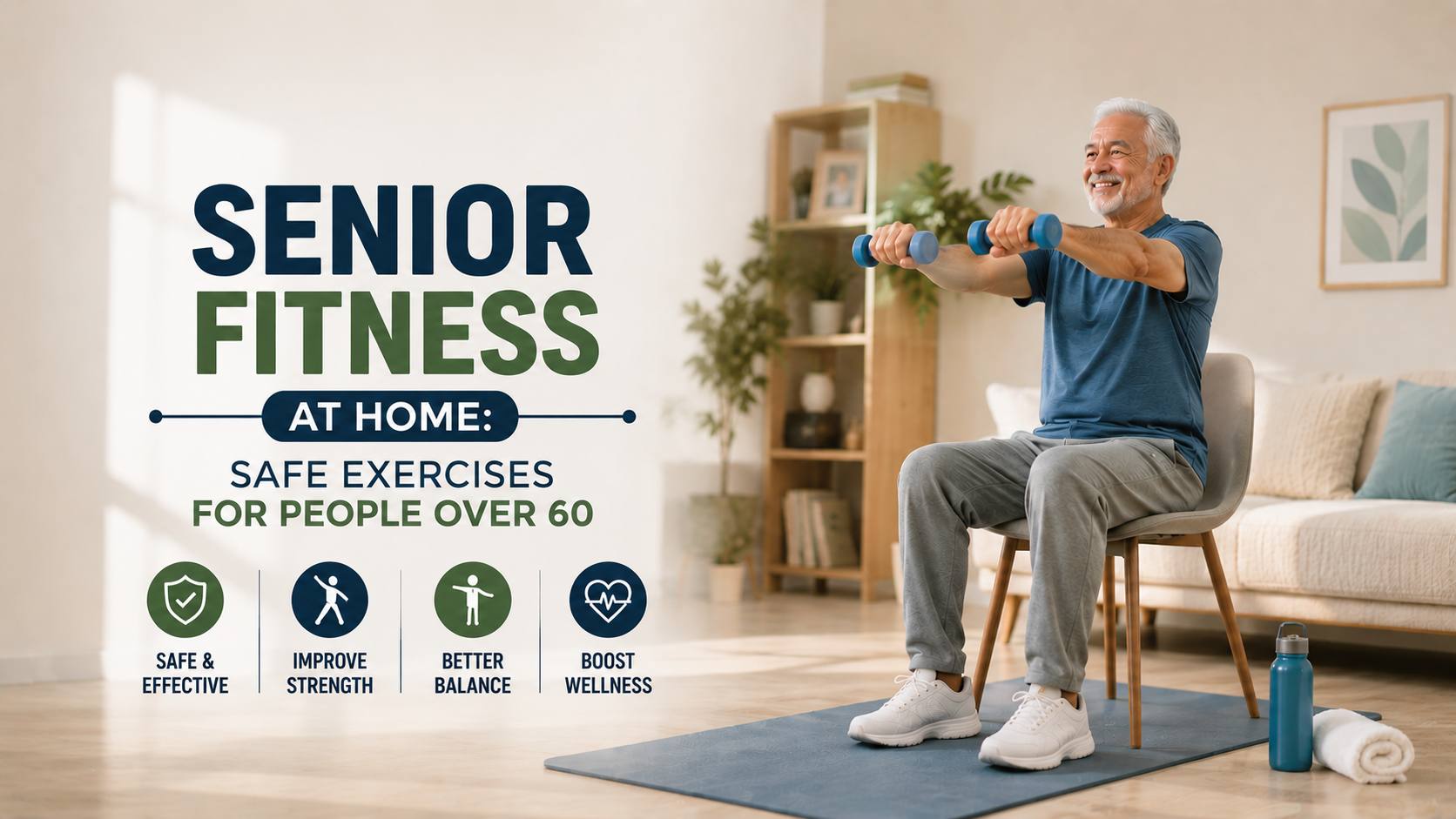
Senior Fitness at Home: Safe Exercises for People Over 60
Getting Older Does Not Mean Getting Weaker
Getting older does not mean getting weaker. It means being smarter about how you move.
After 60, regular exercise is one of the most powerful things you can do for your health. It reduces the risk of falls, keeps your joints mobile, maintains muscle strength, supports heart health, improves mood, and helps you stay independent longer.
The challenge is that most fitness content is designed for 25-year-olds. If you are over 60 (or helping an older family member get started), you need exercises that are safe, effective, and adapted to where your body actually is right now.
Why Exercise Is Critical After 60
Here is something striking: the single biggest predictor of quality of life in your 70s and 80s is how active you are in your 60s.
Regular exercise for seniors:
- Reduces the risk of falls by 23 to 34 percent (falls are the leading cause of injury-related death in older adults)
- Slows muscle loss, which happens at 3 to 5 percent per decade after 30 and accelerates after 60
- Reduces the risk of heart disease, type 2 diabetes, and certain cancers
- Improves bone density and reduces fracture risk
- Reduces symptoms of depression and anxiety
- Maintains cognitive function and reduces dementia risk
- Supports healthy blood pressure and cholesterol
The World Health Organisation recommends at least 150 minutes of moderate-intensity activity per week for adults over 65, plus balance and strength exercises 2 to 3 days per week. Most older adults are not close to this.
What Changes in Your Body After 60
Understanding why your body feels different helps you exercise smarter.
Muscle mass decreases. After 60, you may lose 1 to 2 percent of muscle mass per year without exercise. This is called sarcopenia, and it is why many seniors feel weaker and tire more easily. The good news: resistance exercise directly counters this.
Bone density decreases. Especially in women after menopause. Weight-bearing exercises such as standing exercises and walking help maintain bone density.
Balance declines. The inner ear, vision, and proprioception (your sense of where your body is in space) all change with age. Balance exercises can significantly reduce fall risk.
Joints become stiffer. Cartilage thins and joint fluid decreases. Low-impact exercise keeps joints lubricated and reduces stiffness.
Recovery takes longer. Your muscles need more time to repair after exercise. Building in rest days is not optional at this stage; it is essential.
Safe Home Exercises for Seniors
Strength Exercises
Sit-to-Stand (The Most Important Exercise for Seniors)
This exercise directly strengthens the legs, which are the muscles most critical for maintaining independence.
- Sit in a sturdy chair with feet flat on the floor, hip-width apart
- Lean slightly forward and push through your heels to stand fully upright
- Slowly lower back down, controlling the descent
- Use your hands on the armrests to assist if needed
Start with 5 to 8 repetitions. Work toward 10 to 15 without using your hands.
Wall Push-Ups
Builds upper body strength without any floor work.
- Stand facing a wall, an arm's length away, palms flat at shoulder height
- Bend elbows to bring chest toward the wall, then push back
- Keep your body in a straight line throughout
- 10 to 15 repetitions, 2 to 3 sets
Heel Raises
Strengthens calves and ankles and directly reduces fall risk.
- Stand behind a chair, hands resting lightly on the back for balance
- Rise up onto your toes, hold for 2 seconds, lower slowly
- 15 to 20 repetitions, 2 to 3 sets
Resistance Band Rows
Strengthens the back and improves posture.
- Loop a resistance band around a door handle
- Sit in a chair facing the door, holding one end in each hand
- Pull the band toward your body, squeezing shoulder blades together, then slowly release
- 10 to 12 repetitions, 2 to 3 sets
Important: Always warm up for 5 minutes before starting any exercise session (gentle marching, arm circles, slow walking). For seniors, skipping the warm-up significantly increases the risk of muscle strain and joint discomfort.
Balance Exercises
Single Leg Stand
- Stand behind a chair, hands resting lightly on the back
- Lift one foot slightly off the floor and balance on the other leg
- Hold for 10 to 30 seconds, then switch legs
- As this becomes easier, try with fingertips only, then without holding the chair
Tandem Walk (Tightrope Walk)
- Walk in a straight line, placing one foot directly in front of the other (heel to toe)
- Keep arms out to the sides for balance
- Walk 10 to 15 steps forward and back
- Do this along a wall or hallway for safety when first starting
Weight Shifts
- Stand with feet hip-width apart, hands on a chair back
- Slowly shift your weight onto your right foot, lifting your left foot slightly, hold for 5 to 10 seconds
- Shift to the other side
- 10 repetitions each side
Cardiovascular Exercises
Marching in Place
Easy, safe, and effective for raising your heart rate indoors.
- Stand or sit in a chair and lift your knees alternately, swinging arms naturally
- Begin with 3 to 5 minutes continuously and work toward 10 to 15 minutes
Walking
Still one of the best exercises for seniors. Aim for 20 to 30 minutes of brisk walking daily. Use a walking stick if balance is a concern on uneven ground.
Seated Aerobics
For those with significant mobility limitations, seated aerobics provide real cardiovascular benefit: fast arm circles, seated leg kicks, seated side bends, and seated marching with big arm swings all count.
Flexibility and Mobility Exercises
- Neck rolls: Sit tall and slowly drop your right ear toward your right shoulder, hold for 15 seconds, then repeat on the left. Never roll your head fully backward
- Ankle circles: Sit in a chair, lift one foot slightly, and rotate the ankle in slow circles, 10 times in each direction, then switch feet
- Hip flexor stretch: Stand behind a chair for support, take a small step back with one foot, gently tuck your pelvis under, and hold for 20 to 30 seconds each side. This reduces the forward-lean posture common in older adults
Sample Weekly Routine for People Over 60
A realistic, manageable weekly plan:
- Monday: 20-minute walk plus 10 minutes of balance exercises
- Tuesday: Strength exercises (sit-to-stand, wall push-ups, heel raises, rows), 25 to 30 minutes
- Wednesday: Gentle yoga or stretching, 20 to 25 minutes
- Thursday: 20-minute walk plus 10 minutes of balance exercises
- Friday: Strength exercises, 25 to 30 minutes
- Saturday: 30-minute walk or gentle swimming
- Sunday: Rest or light stretching
Total active time: approximately 150 to 180 minutes, meeting WHO guidelines.
For a gentle and structured introduction to yoga as part of this routine, see morning yoga routine for beginners at home.
Safety Tips and What to Avoid
Always:
- Warm up for 5 minutes before exercising and cool down with 5 minutes of stretching after
- Breathe consistently throughout exercises (never hold your breath)
- Stay hydrated before, during, and after
- Exercise with someone nearby, especially when starting
Stop and rest immediately if you experience:
- Chest pain or pressure
- Unusual shortness of breath
- Dizziness or lightheadedness
- Sharp joint pain (different from normal muscle fatigue)
- Heart palpitations
Avoid:
- Exercises that require lying on the floor if getting up and down is difficult (modify to seated or standing versions instead)
- High-impact activities (jumping, running on hard surfaces) if you have joint issues or osteoporosis
- Holding your breath during strength exercises, which raises blood pressure
- Starting with too much too soon; begin with 2 to 3 times per week and progress gradually
Nutrition for Senior Fitness
Exercise and nutrition work together, and senior fitness depends on getting both right.
Protein: Older adults need more protein per kilogram of body weight than younger adults (1.0 to 1.2 grams per kg daily) to counter muscle loss. Include a protein source at every meal. For a full guide to meeting protein needs through Indian food, see why diet plans fail without fitness guidance.
Calcium and Vitamin D: Essential for bone health. Dairy products, ragi, sesame seeds, and fortified foods provide calcium. Vitamin D comes mainly from safe sun exposure (15 to 20 minutes daily on arms and legs).
Hydration: Older adults have a reduced sense of thirst but still need 6 to 8 glasses of water daily. Dehydration increases fall risk and fatigue.
Avoid long gaps between meals: Blood sugar stability is important for energy during exercise and for recovery afterward.
Why fitnoa Works for Senior Fitness at Home
Most generic fitness platforms are not designed with older adults in mind. fitnoa is.
fitnoa has a dedicated senior mobility programme with live sessions led by expert trainers who understand the unique needs of people over 60:
- Tailored senior programmes that account for common age-related considerations including joint sensitivity, balance, and cardiovascular health, with safe progressions built in
- AI posture tracking with a live trainer: For older adults, correct exercise form is more important than at any other life stage. Improper technique during sit-to-stand or resistance exercises places excess load on joints and significantly increases injury risk. fitnoa's real-time correction prevents this
- Complete privacy: Only you and your trainer can see each other during every session. No strangers watching, no uncomfortable camera angles
- Detailed post-session reports: Accuracy, calories burned, reps completed, and progress over time so you always know your training is working
- Personalised nutrition plans addressing the specific needs of older adults, including adequate protein, calcium, and vitamin D, designed alongside the fitness programme from the start
- One accessible price covering live coaching and nutrition support together
Key Takeaways
- Exercise after 60 is one of the most important things you can do for health, independence, and quality of life
- A complete senior fitness programme includes strength training, cardio, balance, and flexibility
- Sit-to-stand, wall push-ups, heel raises, and single leg stands are the foundational exercises
- Start with 2 to 3 days per week and build to 5 days over 4 to 6 weeks
- Safety comes first: warm up, stay hydrated, and never push through sharp pain
- Protein, calcium, and vitamin D are especially important nutrients for seniors who exercise
Related reads you may find helpful
Frequently asked questions
Everything you need to know
Get a Senior Fitness Programme Built Around Your Body and Goals
fitnoa's dedicated senior mobility programme pairs live expert coaching with personalised nutrition support, all from the comfort and privacy of your home. Sessions are tailored to your current fitness level, with safe progressions and real-time form guidance at every step. Try your first class completely free.