
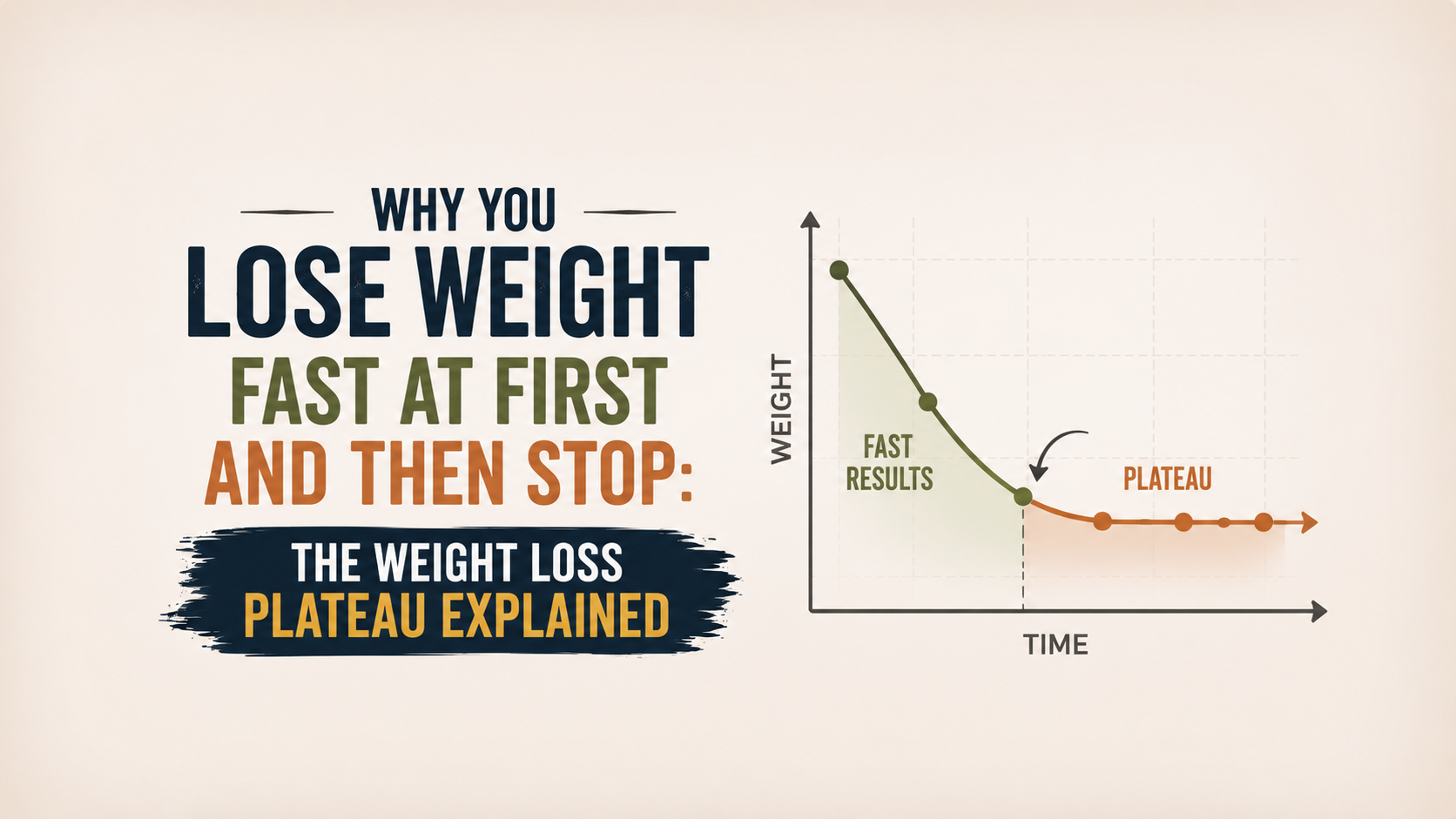
Why You Lose Weight Fast at First and Then Stop: The Weight Loss Plateau Explained
The first two weeks felt amazing. The scale moved every single day. Your clothes started feeling looser. You felt motivated and in control.
And then, somewhere around week four or five, it just stopped. Same diet, same exercise, but the scale will not budge.
This experience is so common it has a name: the weight loss plateau. Understanding why it happens is the key to breaking through it, rather than getting discouraged and giving up.
Why You Lose Weight Fast in the Beginning
The rapid weight loss in the first one to two weeks of a new diet or exercise routine is real, but it is somewhat misleading about what is actually happening in your body.
Water Weight Loss
When you reduce carbohydrate intake (even moderately), your body uses up stored glycogen, the storage form of carbohydrate in your muscles and liver. Each gram of glycogen is stored with approximately 3 to 4 grams of water.
As glycogen stores deplete in the first week or two, you lose this associated water weight, which can account for 1 to 3 kg of "weight loss" that is not actual fat loss.
Reduced Bloating and Inflammation
Cutting out processed foods, excess sodium, and inflammatory foods often reduces bloating and water retention fairly quickly, contributing to the scale moving faster initially.
Genuine Early Fat Loss
There is also real fat loss happening in this period, especially with a significant calorie deficit. However, the water weight and reduced bloating mean the first weeks typically show faster scale movement than your sustainable, ongoing rate of fat loss.
What a Weight Loss Plateau Actually Is
A plateau is a period, typically lasting at least 2 to 3 weeks, where your weight stays essentially the same despite maintaining the same diet and exercise habits that were previously producing weight loss.
This is different from normal day to day weight fluctuations (which can vary by 1 to 2 kg due to water retention, hormonal cycles, and food intake) and represents a more sustained stall in progress.
The Main Causes of Plateaus
1. Your Calorie Needs Have Decreased
As you lose weight, your body requires fewer calories to maintain its new, smaller size. Someone who needed 2,000 calories to maintain their weight at 75 kg needs meaningfully fewer calories at 68 kg, simply because a smaller body requires less energy.
If you have not adjusted your intake downward as you have lost weight, what was once a deficit gradually becomes maintenance, and weight loss naturally stalls.
2. Metabolic Adaptation
Beyond the simple math of needing fewer calories at a lower weight, your body also undergoes metabolic adaptation in response to a sustained calorie deficit, as explained in does eating less really help you lose weight, becoming somewhat more efficient at using energy than the simple math would predict.
3. Unconscious Increases in Food Intake
Over weeks and months, portion sizes commonly creep up without conscious awareness, especially as initial motivation and strict tracking relax. Small increases, like an extra roti here or slightly larger portions there, can accumulate into a meaningful calorie increase.
4. Reduced Non-Exercise Activity
As you lose weight and potentially feel more fatigued from a sustained deficit, you may unconsciously move less throughout the day, reducing your total daily calorie expenditure without realising it.
5. Your Body Adapting to Exercise
The same workout that was challenging and calorie burning at the start becomes more efficient for your body over time. As your fitness improves, the identical exercise burns somewhat fewer calories.
6. Water Retention Masking Fat Loss
Various factors, including increased exercise, hormonal fluctuations, sodium intake, and stress, can cause temporary water retention that masks ongoing fat loss on the scale.
Metabolic Adaptation Explained
Metabolic adaptation is your body's response to a sustained calorie deficit, where your metabolism becomes somewhat more efficient, burning fewer calories than predicted based on your current weight and activity level alone.
This adaptation happens through several mechanisms: reduced resting metabolic rate, reduced calorie burn during exercise, reduced non-exercise activity, and in some cases, modest reductions in thyroid hormone conversion.
The practical implication: as you lose weight, your actual calorie needs decrease by more than simple calculations based on body weight alone would suggest. This is a normal, expected physiological response, not a sign that something is wrong with your effort.
The Water Retention Factor
This is one of the most overlooked reasons plateaus seem to happen even when fat loss may actually be continuing.
Common causes of temporary water retention:
- New or increased exercise: especially new strength training, which can cause temporary water retention in muscles, sometimes lasting 1 to 2 weeks
- Hormonal fluctuations: for women, the luteal phase of the menstrual cycle commonly involves water retention of 1 to 2 kg or more
- High sodium intake: eating out, processed foods, or simply a higher sodium day
- Stress and cortisol: elevated cortisol can contribute to water retention independent of actual fat changes
- Carbohydrate intake variations: higher carbohydrate days lead to more glycogen storage, which comes with associated water weight
Important: Tracking only the scale during a plateau can be misleading. Waist circumference, progress photos, how clothes fit, and strength improvements often tell a more complete story.
How Long Do Plateaus Typically Last?
Most weight loss plateaus, when properly addressed, resolve within 2 to 4 weeks. However, if no adjustments are made, a plateau can persist indefinitely, since your body has simply reached a new equilibrium between calories consumed and calories burned at your current habits.
A plateau is not necessarily a sign that weight loss has become impossible, but rather a sign that your current approach matches your current calorie needs, and an adjustment is needed.
How to Break Through a Plateau
Reassess Your Actual Calorie Intake
Track your food intake honestly and accurately for several days, since portion creep is extremely common, even if your planned meals look the same on paper.
Adjust Your Calorie Target Downward Modestly
A modest downward adjustment, typically 100 to 200 calories, is often sufficient to restart progress, rather than a dramatic cut, which risks triggering further metabolic adaptation and muscle loss.
Increase Strength Training
If you have been doing primarily cardio, adding or increasing strength training for beginners at home helps preserve and build muscle, which supports your metabolic rate.
Point 1: Reassess your actual intake honestly, since portion creep is common even when meals "look the same." Point 2: Adjust your calorie target down modestly, by 100 to 200 calories, rather than cutting aggressively. Point 3: Add or increase strength training to preserve muscle and support your metabolic rate.
Consider a Planned Diet Break
For people who have been in a calorie deficit for many weeks or months, a planned period of eating at maintenance calories (typically 1 to 2 weeks) can help reduce metabolic adaptation, lower stress hormones, and improve adherence.
Increase Daily Movement
Focus on increasing non-exercise activity: taking the stairs, walking more throughout the day, standing rather than sitting when possible. If you are deciding between activity types, walking vs running for weight loss breaks this down further.
Prioritise Sleep and Stress Management
Since both significantly impact hunger hormones and cortisol, improving sleep quality and actively managing stress can directly support breaking through a plateau. Learn more in how sleep affects weight loss and hormones in women.
Be Patient and Look Beyond the Scale
Track waist circumference, how your clothes fit, progress photos, and strength improvements alongside scale weight. Sometimes a plateau on the scale coincides with continued improvements in body composition.
When a "Plateau" Is Actually Something Else
Sometimes what feels like a plateau has a different underlying cause worth considering:
- Underlying hormonal or thyroid issues: if a plateau persists for many weeks despite a clear, consistent deficit, an underlying health condition may be worth discussing with a doctor. See signs your hormones might be out of balance for more.
- Unsustainable initial approach: if your starting plan was extremely restrictive, the plateau may be your body protecting itself, as explored in does eating less really help you lose weight
- Realistic body weight range: sometimes what feels like a stubborn plateau is your body settling into a genuinely healthy, sustainable weight for your individual physiology
Why fitnoa Works for Breaking Through Weight Loss Plateaus
Varied Workouts Designed Around Your Goals
fitnoa offers live fitness sessions across yoga, cardio, strength training, and bodyweight exercises, ensuring your program evolves over time rather than staying static, which directly helps address your body's natural adaptation to repeated, unchanging routines.
AI Posture Tracking With a Live Trainer by Your Side
Every session uses AI to monitor your posture and form in real time, with your trainer guiding you live and adjusting your program as your fitness improves, ensuring your workouts remain appropriately challenging.
A Detailed Fitness Report After Every Session
After every session, fitnoa provides a complete report covering accuracy, performance, BMI, calories burned, and reps completed, making it easier to identify whether a plateau is genuine or whether body composition is still improving.
Complete Privacy, Even in Group Sessions
fitnoa ensures only you and your trainer can see each other during sessions, creating a space where you can openly discuss frustrations like a stalled plateau without judgement.
Programs Built Around Your Specific Health Needs
fitnoa's weight loss program is built to evolve with your progress, recognising that the approach that worked for your first 5 kg of loss often needs adjustment for continued progress.
A Personalised Diet Plan That Works Alongside Your Fitness Program
Your fitnoa nutrition plan is reassessed and adjusted as your body and weight change, ensuring your calorie targets stay appropriately aligned with your decreasing calorie needs.
Affordable Pricing That Covers Everything in One Place
fitnoa combines live fitness coaching and personalised nutrition guidance under one accessible plan, giving you ongoing expert support to navigate plateaus as they arise.
Key Takeaways
- Rapid initial weight loss often includes significant water weight loss, not purely fat loss, which is why the rate naturally slows afterward
- A true plateau is a sustained stall (2 to 3 weeks or more) despite consistent diet and exercise habits
- As you lose weight, your calorie needs decrease, meaning your previous deficit may have gradually become maintenance
- Metabolic adaptation, portion creep, and reduced non-exercise activity all commonly contribute to plateaus
- Water retention from new exercise, hormonal cycles, or sodium intake can mask ongoing fat loss on the scale
- Breaking through a plateau typically involves reassessing calorie intake, adjusting targets modestly, increasing strength training, or taking a planned diet break
- Tracking measurements beyond the scale (waist circumference, photos, strength) provides a more complete picture during a plateau
Related reads you may find helpful
Frequently asked questions
Everything you need to know
Stuck on a Plateau? Let's Break Through It Together.
Hit a wall with your weight loss? fitnoa adjusts your fitness program and nutrition plan as your body changes, with a live trainer tracking your real progress, not just the scale, so you keep moving forward.