
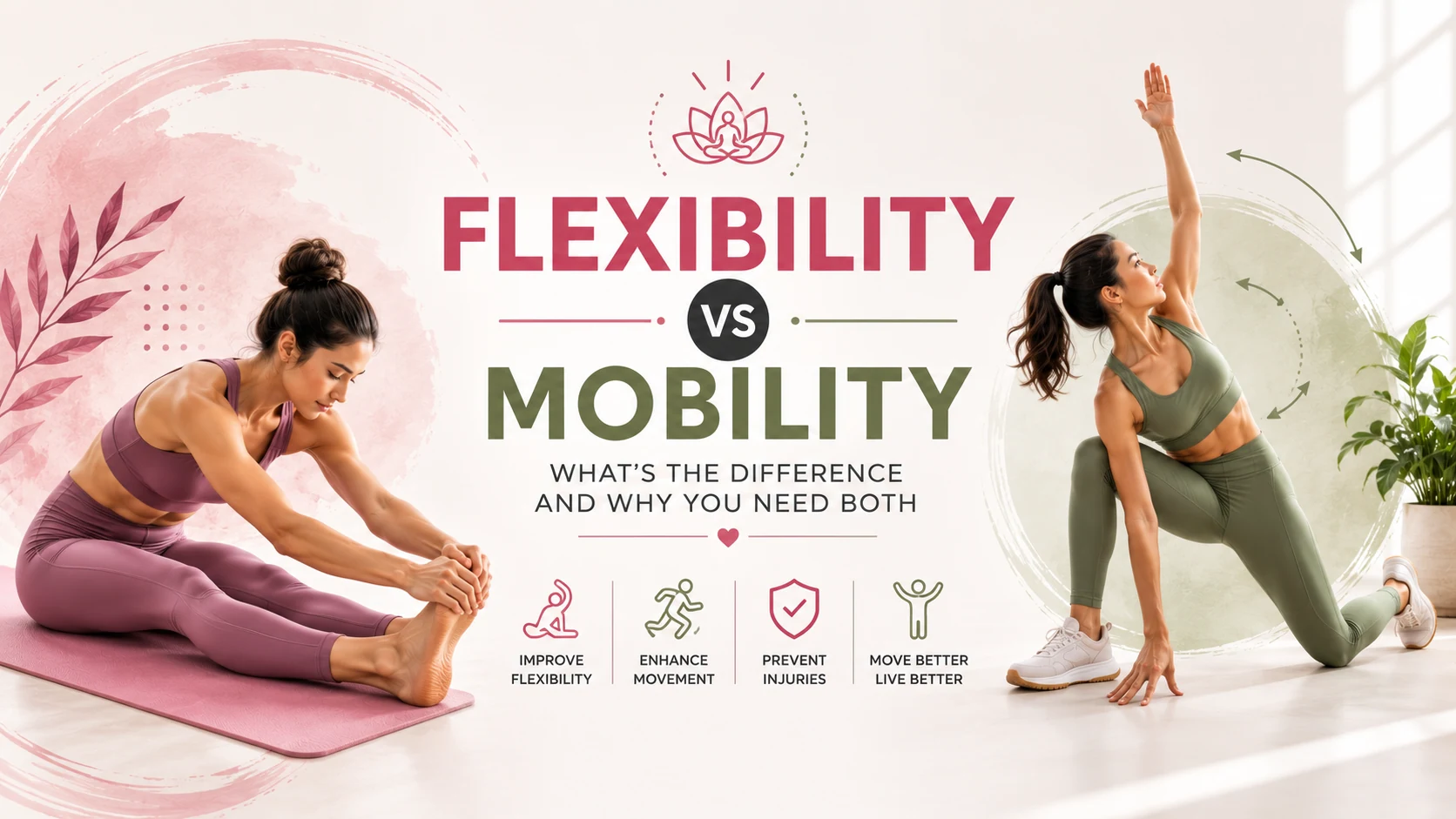
Flexibility vs Mobility: What's the Difference and Why You Need Both
Introduction
Everyone talks about being flexible, but flexibility is only half the story.
You can be extremely flexible (touch your toes easily) but still move poorly or get injured.
You can be not very flexible but move great and stay injury-free.
The difference is mobility.
Flexibility and mobility sound like the same thing, but they're completely different. Understanding this distinction changes how you train and dramatically improves your results.
This guide explains what each means, why you need both, and how to build them.
What is Flexibility?
Flexibility is your maximum range of motion in a joint. It's a static property.
When you stand and touch your toes, you're displaying flexibility in your hamstrings.
When you hold a deep squat, you're displaying flexibility in your hips and ankles.
Flexibility is measured at the end range of motion. It's passive. You're not moving.
Why Flexibility Alone Isn't Enough:
- You can be extremely flexible but have poor proprioception (awareness of where your body is in space)
- You can do a full split but pull a muscle reaching for something
- You can touch your toes but throw out your back bending over
This happens because flexibility without strength and control is useless.
What is Mobility?
Mobility is the ability to move your joints through their full range of motion with strength, control, and stability.
It's dynamic. You're actively using muscles to move through range of motion.
Mobility combines:
- Flexibility (passive range of motion)
- Strength (ability to control that range)
- Stability (control throughout the movement)
- Proprioception (awareness of position)
- Neuromuscular control (your brain telling muscles how to move)
When you squat deeply and powerfully, you're demonstrating mobility.
When you reach overhead with control, you're demonstrating mobility.
Mobility is functional. Real-world movement requires it. For a deeper look at building it through training, see our guide on mobility training.
Key Differences Summarized
| Aspect | Flexibility | Mobility |
|---|---|---|
| Definition | Passive range of motion | Active, controlled movement through range |
| Measurement | Static stretch at end range | Dynamic movement with load |
| Requires | Muscle length | Muscle length, strength, stability, control |
| Real-world use | None really | Everything (picking up, reaching, squatting, moving) |
| Injury prevention | Limited | Excellent |
| Movement quality | Not necessarily | Yes |
Simple Example:
You can hold a deep yoga squat (flexibility).
But when you do a heavy barbell squat, your form breaks down (lack of mobility).
Your flexibility is fine. Your mobility is poor.
Why You Need BOTH
Flexibility without Mobility = Useless You can touch your toes but hurt yourself reaching. You're flexible but not mobile.
Mobility without Flexibility = Limited You move great but only in a small range. Your mobility is limited by lack of flexibility.
The ideal is high mobility, which includes sufficient flexibility.
How to Build Flexibility
Static Stretching (After Workouts)
Hold stretches for 30 seconds, allowing muscles to relax.
Best stretches:
- Hamstring stretch
- Quad stretch
- Hip/pigeon stretch
- Shoulder stretch
- Back/spinal twist
Do this 2-3 times per week for 10 minutes.
Yoga and Yin Yoga
Long-held poses that gently increase range of motion.
Yin yoga is especially good for flexibility. If you're new to a regular practice, morning yoga routine for beginners is a good place to start.
Foam Rolling
Self-massage that releases muscle tightness and improves range of motion.
Spend 30 seconds to 1 minute on each muscle group.
Active Stretching
Move through range of motion with control but without force.
Example: slow, controlled leg swings.
Important: Flexibility improvements take weeks. Be patient and consistent. Stretching 5 minutes daily beats stretching 30 minutes once per week.
For more on this, read our article on stretches that undo hours of sitting.
How to Build Mobility
Strength Training Through Full Range
Do full range of motion squats, push-ups, and other movements.
Going deep into your range while under load builds mobility. This is also why correct form matters so much, since wrong form is killing your results when you cut your range short.
Bodyweight Movements
Pistol squats, handstands, crawling patterns, and other complex movements build incredible mobility.
Dynamic Stretching
Controlled movements through range of motion.
Example: walking lunges with a forward reach.
Stability Training
Planks, single-leg work, and balance training teach your body to stabilize through range.
Combination Movements
Yoga vinyasas, Turkish get-ups, and flowing sequences build mobility.
These combine flexibility, strength, stability, and control.
Mobility Exercises for Common Restrictions
Hip Mobility (Most People Are Tight Here)
90-90 Stretch:
- Sit with one leg bent in front (90 degrees), one leg bent to side (90 degrees)
- Gently fold forward
- Hold 30 seconds per side
Deep Squat Hold:
- Squat as deep as comfortable
- Keep weight in heels
- Hold 1-2 minutes daily
Leg Cradle:
- Standing, hold one knee to chest and pull inward
- Hold 30 seconds per side
Shoulder Mobility
Cat-Cow Stretch:
- Hands and knees
- Alternate arching and rounding your back
- 10 reps
Shoulder Dislocate (with band or stick):
- Hold band at shoulder width in front
- Pull up and behind head
- Return forward
- 10 reps
Thread the Needle:
- All fours, reach under body with one arm
- Rotate chest open
- Hold 30 seconds per side
Ankle Mobility
90-90 Ankle Rocks:
- Squat position
- Shift weight side to side
- Feel ankles opening
Tibialis Stretch:
- Kneel with tops of feet on ground
- Gently sit back
- Feel front of ankles stretching
Point 1: Build hip mobility with the 90-90 stretch, deep squat hold, and leg cradle Point 2: Build shoulder mobility with cat-cow, shoulder dislocates, and thread the needle Point 3: Build ankle mobility with 90-90 ankle rocks and the tibialis stretch
Program Structure: Balance Flexibility and Mobility
Optimal Weekly Structure:
- Monday: Strength training (builds mobility through full range)
- Tuesday: Light mobility work and stretching
- Wednesday: HIIT or cardio
- Thursday: Yoga or flow-based training (builds mobility and flexibility)
- Friday: Strength training (builds mobility)
- Saturday: Long, gentle stretching and mobility work
- Sunday: Rest or light walking
This provides balanced development of both qualities. To round out the strength days, strength training for beginners at home is a useful starting guide.
For more on this, read our article on a 5-minute warm-up routine.
Common Mistakes
Mistake 1: Only Stretching, Never Strength Training You can be very flexible but terrible at moving. You need strength through range.
Mistake 2: Strength Training Without Stretching You stay tight and eventually develop limitations. You need flexibility to support mobility.
Mistake 3: Stretching Cold Muscles Warm up first, then stretch. Cold muscles don't stretch safely.
Mistake 4: Expecting Instant Results Mobility changes take weeks. Be consistent.
Mistake 5: Stretching Before Workouts Static stretching before workouts actually decreases performance.
Dynamic stretching before, static stretching after. If your results have plateaued despite training hard, this guide on why you're not seeing results from your workouts covers other common culprits.
Self-Assessment: How's Your Mobility?
Test Your Mobility:
- Deep Squat: Squat as low as possible. Can you get parallel or lower? Good mobility means yes, poor means barely bent knees.
- Reach Behind Back: Try to clasp hands behind your back. Can you? Good mobility means yes.
- Touch Toes: Forward fold. Can you reach toes? Good mobility means yes.
- Shoulder External Rotation: With elbow bent 90 degrees, can you get your forearm parallel to ground? Good mobility means yes.
- Lunge: Can you get back knee close to ground in a lunge? Good mobility means yes.
Score yourself: How many did you pass?
- 5/5: Excellent mobility
- 4/5: Good mobility
- 3/5: Average, room for improvement
- 2/5 or less: Poor mobility, needs work
How fitnoa Helps You Build Both Flexibility and Mobility
Developing real flexibility and mobility together is much easier with structured, guided sessions, and that's exactly what fitnoa offers.
Live, Trainer-Guided Sessions Across Yoga, Cardio, and Strength
fitnoa combines yoga, cardio, strength training, and bodyweight exercises in one place, so you get both the full-range strength work that builds mobility and the yoga practice that builds flexibility, all guided live by a trainer.
Real-Time Posture Tracking for Safer Range of Motion
Since mobility depends on moving safely through full range under load, fitnoa's AI tracks your posture in real time, with your trainer correcting your form as you move deeper into each exercise.
Detailed Reports to Track Movement Progress
Because flexibility and mobility improvements happen gradually over weeks, fitnoa gives you a full report after every session, covering accuracy, performance, BMI, calories burned, and reps performed, so you can see your movement quality improving session by session.
Private Sessions, Even in Groups
Working through tight hips, shoulders, or ankles can feel personal. Even in group sessions, fitnoa keeps your screen private, just you and your trainer.
Plans Built Around Your Body's Restrictions
fitnoa offers plans created specifically for your body's needs, including weight loss, pregnancy care, old age mobility, pmos, and diabetes, so your flexibility and mobility work can be matched to your specific limitations.
Personalised Nutrition to Support Recovery
Since recovery supports how well your body adapts to stretching and mobility work, fitnoa pairs each plan with a personalised diet plan based on your goals and reports.
Affordable, All-in-One Access
Workout and nutrition support together, at one place, at a reasonable price, so building both flexibility and mobility doesn't mean juggling separate yoga studios, gyms, and trainers.
Learn how fitnoa's yoga and holistic wellness program can help.
Key Takeaways
Flexibility is passive range of motion. Mobility is the ability to use that range with strength and control, and it's mobility that actually protects you from injury and improves real-world movement.
Build flexibility with static stretching, yoga, and foam rolling. Build mobility with full-range strength training, dynamic stretching, and stability work.
You need both, but if you had to prioritize one, prioritize mobility, since flexibility without control is the weaker half of the equation.
Related reads you may find helpful
- Training: Why It Matters More Than You Think (Beginner Guide)
- Strength Training for Beginners at Home: Complete Guide (No Gym Needed)
- Wrong Form is Killing Your Results: Here's How to Fix It at Home
- Why You're Not Seeing Results From Your Workouts (And How to Fix It)
- Morning Yoga Routine for Beginners at Home in India (10 Minutes, No Experience Needed)
Frequently asked questions
Everything you need to know
Move Better, Not Just Stretch More
Real flexibility means nothing without the mobility to use it safely. Join fitnoa for live, trainer-guided yoga and strength sessions that build both together, so you move with confidence in everyday life.