
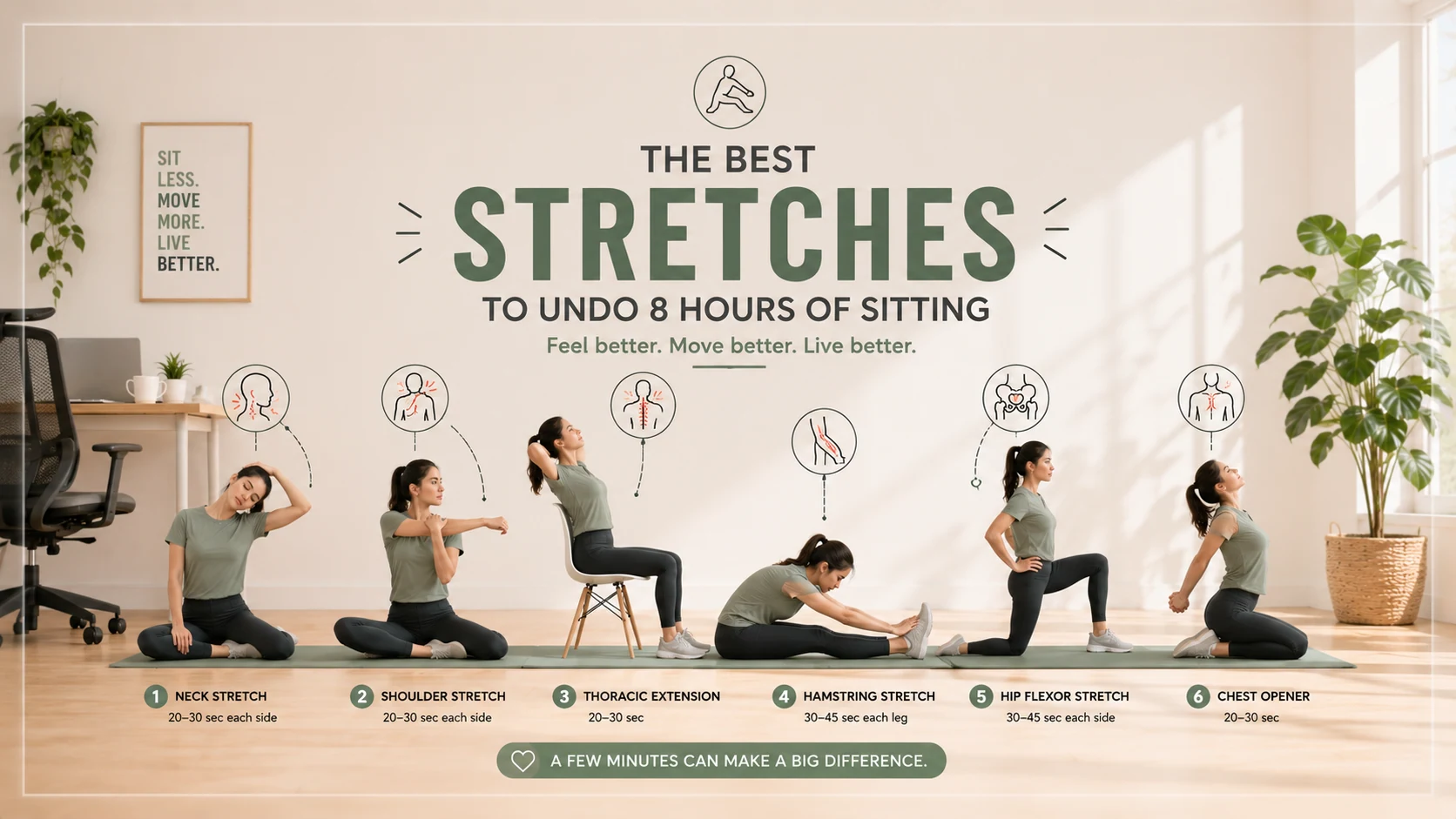
The Best Stretches to Undo 8 Hours of Sitting
By the time most office workers stand up at the end of the day, their body has spent eight hours folded into roughly the same shape. Hips bent. Shoulders rounded. Spine curved forward. It is no wonder so many people feel stiff, tight, and slightly hunched once they finally stand.
The good news is that this stiffness is highly responsive to the right stretches, done consistently. This article breaks down exactly which stretches matter most after a full day of sitting, why each one works, and how to fit them into a realistic daily routine.
Why Sitting for 8 Hours Tightens Specific Muscles
Before jumping into the stretches themselves, it helps to understand exactly what sitting does to your muscles, because this explains why certain stretches matter far more than others.
When you sit, certain muscles shorten because they are held in a contracted position for hours. Other muscles lengthen and weaken because they are stretched passively without being actively used. This imbalance, not sitting itself, is what creates the stiffness, discomfort, and postural changes most people notice. Learn more in Sitting All Day.
Muscles that typically tighten from sitting:
- Hip flexors (front of the hip)
- Hamstrings (back of the thigh)
- Chest muscles (pectorals)
- Lower back muscles (in some sitting postures)
Muscles that typically weaken from sitting:
- Glutes
- Core muscles
- Upper back and rear shoulder muscles
This is why the most effective stretching routine after sitting focuses specifically on releasing the tight muscles listed above, ideally alongside some activation of the weakened ones, rather than a random, generic stretch sequence.
The Best Stretches to Undo 8 Hours of Sitting
1. Standing Hip Flexor Stretch
Step one foot forward into a gentle lunge position, keeping your back knee softly bent or resting on the floor with support. Gently push your hips forward until you feel a stretch at the front of the back leg's hip. Hold for 30 seconds, then switch sides.
Why it matters: The hip flexors are among the most consistently tightened muscles from sitting, since they stay in a shortened position for hours. Loosening them can noticeably reduce that "tight" feeling in the front of the hips after standing up.
2. Seated or Standing Forward Fold (For Hamstrings)
Standing with feet hip-width apart, gently hinge forward from your hips, letting your arms hang toward the floor, knees slightly bent if needed. Hold for 30 seconds, breathing steadily.
Why it matters: Sitting keeps the hamstrings in a shortened position too, which can contribute to lower back tightness, since tight hamstrings pull on the pelvis and affect lower back posture.
3. Doorway Chest Opener
Stand in a doorway, place your forearms on either side of the frame at shoulder height, and gently lean forward until you feel a stretch across your chest. Hold for 30 seconds.
Why it matters: Hours of reaching forward toward a keyboard or phone tightens the chest muscles and contributes directly to the rounded shoulder posture covered in our tech neck article.
4. Seated Spinal Twist
Sit tall, place one hand on the opposite knee and the other behind you for support, and gently twist your torso, holding for 20 to 30 seconds before switching sides.
Why it matters: Sitting limits natural spinal rotation throughout the day. This stretch restores some of that mobility and can relieve a build-up of tension along the spine.
5. Child's Pose
Kneel on the floor, sit back toward your heels, and stretch your arms forward along the floor, lowering your chest toward the ground. Hold for 30 to 60 seconds, breathing deeply.
Why it matters: This gently stretches the lower back, hips, and shoulders simultaneously, making it an efficient, calming way to release tension built up across several areas at once.
6. Figure-Four Stretch (For the Glutes and Hips)
Lying on your back, cross one ankle over the opposite knee, then gently pull the uncrossed leg toward your chest until you feel a stretch in the hip and outer glute of the crossed leg. Hold for 30 seconds, then switch.
Why it matters: Sitting compresses the glutes and hip rotators for hours. This stretch is particularly helpful for people who notice hip tightness or mild discomfort radiating into the lower back or outer thigh.
7. Cat-Cow Stretch
On hands and knees, alternate between arching your back upward (cat) and dipping it downward while lifting your chest (cow), moving slowly with your breath for about a minute.
Why it matters: This stretch mobilises the entire spine, counteracting the relatively fixed, often rounded spinal position held throughout a day of sitting.
Important: Bouncing during a stretch, sometimes called ballistic stretching, can increase injury risk. A slow, steady hold is safer and more effective for everyday stiffness.
A 10-Minute Evening Stretch Routine
If you only have time for one structured stretch session a day, here is a complete sequence combining the stretches above, designed to take about 10 minutes.
- Cat-Cow Stretch, 1 minute
- Standing Hip Flexor Stretch, 30 seconds each side
- Standing Forward Fold, 1 minute
- Doorway Chest Opener, 30 seconds
- Seated Spinal Twist, 30 seconds each side
- Figure-Four Stretch, 30 seconds each side
- Child's Pose, 1 to 2 minutes to finish, breathing slowly
This sequence moves from spinal mobility, into hip and hamstring release, into chest and shoulder opening, and finishes with a calming pose, making it a complete, logical flow rather than a random list.
You may also like our guide on mobility training for beginners.
The Role of Breathing in Effective Stretching
Most people focus entirely on the physical positioning of a stretch and overlook breathing, but the two are closely connected. When a muscle is stretched, the nervous system has a natural protective reflex that can cause it to tighten slightly in response to the unfamiliar lengthened position, especially if the stretch is new or the muscle has been tight for a long time.
Slow, deep breathing during a stretch helps calm this protective reflex, allowing the muscle to relax and lengthen more fully than it would with shallow, held breath. This is part of why instructors in yoga and mobility classes consistently emphasise breathing alongside positioning, rather than treating it as a minor detail.
A simple practical approach is to inhale gently as you move into a stretch, then exhale slowly as you ease slightly deeper into the position, repeating this pattern for the duration of the hold. This small adjustment alone can noticeably improve how effective each stretch in this routine feels, particularly for areas that have been tight for months, like the hip flexors and chest. Learn more in Morning Yoga.
Stretching Frequency: How Often Should You Do This?
| Frequency | Best For | Expected Benefit |
|---|---|---|
| Once daily (evening) | Most desk workers with limited time | Noticeable reduction in evening stiffness within 1 to 2 weeks |
| Twice daily (midday and evening) | People with significant stiffness or pain | Faster relief, better daily comfort |
| A few short stretches every 1 to 2 hours | People wanting to prevent stiffness from building at all | Best long-term outcome, prevents tightness rather than just releasing it |
If you can only manage one approach consistently, choose the one you will actually do every day. A simple 10-minute evening routine done daily outperforms an elaborate hourly plan that gets abandoned after three days.
Common Mistakes People Make While Stretching After Sitting
Point 1: Stretching cold muscles aggressively. Gentle, gradual stretching works better than forcing a deep stretch immediately, especially right after standing up from hours of sitting. Point 2: Holding stretches for only a few seconds. Most stretches need at least 20 to 30 seconds to produce a meaningful change in muscle length, rather than a quick 5 second touch. Point 3: Only stretching the back, ignoring the hips. As explained earlier, hip tightness is often the bigger contributor to lower back discomfort after sitting, yet it gets overlooked frequently. Point 4: Bouncing during a stretch. A slow, steady hold is safer and generally more effective for everyday stiffness. Point 5: Stretching only, without any strengthening. Stretching tight muscles without strengthening the weakened ones provides only partial, temporary relief. See Strength Training for a complete approach.
Who Should Be Cautious With These Stretches
If you have a diagnosed disc issue, recent back or hip surgery, or significant existing pain, check with a doctor or physiotherapist before starting these stretches, particularly the forward fold and figure-four stretch, since they may need modification. Pregnant women should also consult their doctor for safe stretching modifications, and fitnoa's pregnancy care program includes movement guidance designed specifically for this purpose. See Is Prenatal Yoga Safe? for more.
How fitnoa Helps You Build an Effective Stretching Habit
Knowing the right stretches is only half the equation. Doing them with correct form and consistently enough to see real change is where most people fall short, often abandoning a stretch routine within the first week because results feel slow or form feels uncertain.
Live Yoga and Mobility Sessions
fitnoa's live yoga and mobility sessions guide you through structured stretching sequences with a real trainer, which removes the guesswork around hold times, breathing, and correct positioning that often makes a self-guided stretch routine less effective than it could be.
AI Posture Tracking
The AI posture tracking feature is especially useful for stretches like the spinal twist and doorway chest opener, where small positioning errors can significantly reduce the benefit. Real-time feedback helps you actually get the stretch right, rather than just going through familiar motions.
Detailed Fitness Reports
Because every session ends with a detailed fitness report covering accuracy and performance, you also get a clear, objective sense of whether your flexibility and mobility are genuinely improving over weeks, rather than relying only on how your body feels on a given evening.
Senior Mobility and General Fitness Programs
For people whose sitting-related tightness has progressed into more specific concerns, like chronic lower back discomfort or hip pain affecting daily mobility, fitnoa's senior mobility and general fitness programs offer more targeted, structured support beyond a basic stretch routine.
Learn how fitnoa's yoga and holistic wellness program can help.
Key Takeaways
- Sitting for long hours specifically tightens the hip flexors, hamstrings, and chest, while weakening the glutes, core, and upper back.
- Effective stretching after sitting should target these specific tight areas rather than following a random sequence.
- A consistent 10-minute daily routine works better than an elaborate plan that is hard to maintain.
- Stretching alone offers only partial relief; combining it with strengthening exercises produces more lasting results.
- Persistent pain, numbness, or significant discomfort should be evaluated by a doctor rather than self-treated through stretching alone.
Related reads you may find helpful
Frequently asked questions
Everything you need to know
Build a Stretching Habit That Actually Sticks
Knowing the stretches is one thing, doing them right and consistently is another. fitnoa's live yoga and mobility sessions guide you through correct form with real-time posture feedback, so every stretch counts.