
Why More Women Are Talking About Hormonal Fitness
The Fitness Conversation Is Changing
Something is shifting in the way women think about fitness.
For decades, the dominant narrative was simple: work harder, eat less, push through. Gyms were designed by and for men. Nutrition science was built on research conducted predominantly on male subjects. Workout programmes were standardised, intensity-focused, and completely indifferent to the hormonal cycles that shape female physiology.
Women who found those programmes difficult were told they weren't trying hard enough. Women who experienced fatigue, mood dips, or injury were told they needed more discipline.
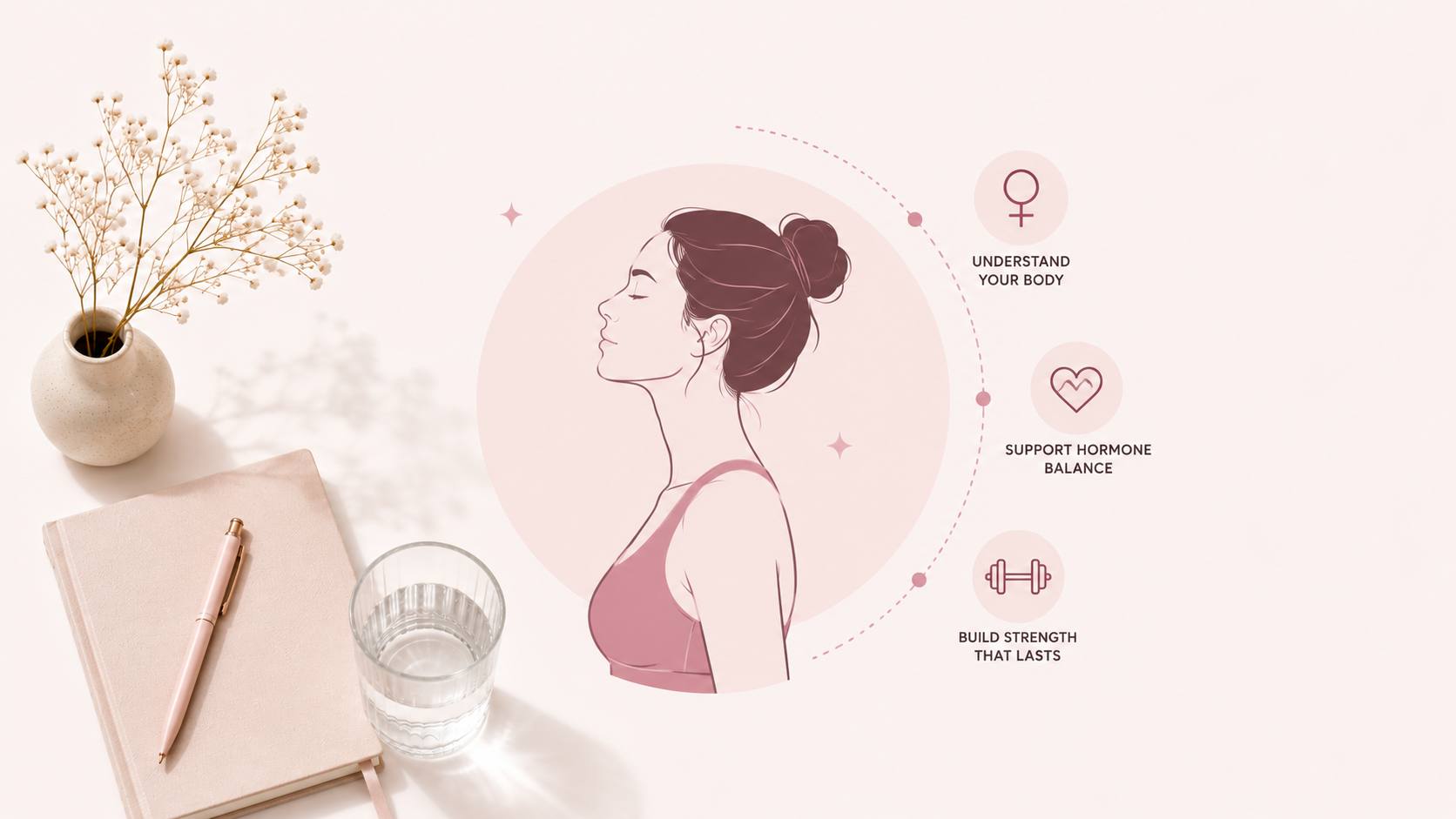
Now, finally, the conversation is catching up to a simple truth: women's bodies are not smaller versions of men's bodies and fitness, to genuinely serve women, needs to be designed around how women's hormones actually work.
This is hormonal fitness. And it's not a trend. It's a correction.
What Is Hormonal Fitness?
Hormonal fitness is an approach to movement, nutrition, and recovery that accounts for the hormonal fluctuations that define the female physiological experience across the menstrual cycle, across life stages, and across conditions like PMOS that significantly alter the hormonal environment.
At its core, hormonal fitness recognises several things that conventional fitness ignores:
- Exercise capacity varies across the cycle — what's optimal in the follicular phase (high energy, higher muscle-building potential) is different from what works in the luteal phase (greater fatigue, need for more recovery)
- Not all exercise benefits hormonal health — excessive HIIT raises cortisol and can actively worsen hormone balance, especially in PMOS
- Women's nutrition needs to account for hormonal cycles — not just macros and calories, but timing, blood sugar management, and endocrine-supportive nutrients
- Recovery is as important as training — for women with hormonal health conditions, rest days and active recovery sessions are therapeutic, not optional
Why Women with PMOS Are Leading This Conversation
Of all the communities driving the hormonal fitness shift, women navigating PMOS are among the most vocal and for good reason.
When you live with a condition driven by hormonal and metabolic dysregulation, the failures of generic fitness advice become impossible to ignore. You've experienced first-hand what happens when you push through with high-intensity training: fatigue deepens, symptoms worsen, the weight doesn't move, and you're left feeling like you failed, when in fact the programme failed you.
Women with PMOS have been asking the questions that are reshaping fitness:
- Why does my body respond differently to the same diet my friend follows?
- Why does working out more sometimes make me feel worse?
- Why are my symptoms worse after certain types of training?
- Why does nobody design fitness programmes around how women's hormones actually work?
These aren't complaints. They're metabolically astute observations and they've been pointing toward a more intelligent approach to fitness for years. For a deeper look at how lifestyle choices affect hormonal health, see managing PCOS with lifestyle and exercise.
The Science Behind Cycle-Aware Training
Understanding the menstrual cycle as a performance variable is gaining traction in sports science and clinical research. Here's why it matters.
The Follicular Phase (Days 1–14)
This phase begins with menstruation and ends at ovulation. As oestrogen rises, so does energy, strength, and cognitive performance. This is typically the best window for higher-intensity training, progressive strength work, challenging cardio, and skill-based movement. Recovery is faster and pain tolerance is higher.
The Ovulatory Phase (Around Day 14)
The brief window around ovulation is a performance peak for many women, energy and motivation are typically high.
Important: Joint laxity can increase slightly around ovulation due to hormonal effects on connective tissue. A thorough warm-up and careful attention to form are especially important during this phase.
The Luteal Phase (Days 15–28)
As progesterone rises post-ovulation, the body shifts into a more recovery-oriented state. Core temperature rises slightly, fatigue increases, and the body's fuel preference shifts toward fat.
This is the time to prioritise moderate training, yoga, mobility, and lower-intensity cardio. Pushing high-intensity training here without adequate recovery often leads to symptom flares in women with PMOS. Explore how yoga affects blood sugar for guidance on restorative movement during this phase.
Menstruation (Days 1–5)
The first days of menstruation are high-symptom for many women, cramping, fatigue, and lower back pain. Gentle movement, yoga, walking, and restorative practices, supports circulation and reduces inflammation without overtaxing an already demanding phase.
- Follicular phase: Prioritise strength training and higher-intensity cardio, your body is primed for it
- Ovulatory phase: Peak performance window, train hard, but warm up thoroughly and watch your form
- Luteal phase: Shift to yoga, mobility, and moderate cardio, recovery is the priority
- Menstruation: Gentle movement only, walking, restorative yoga, and breathwork support the body without strain
For women with PMOS, where cycle lengths and hormone levels vary significantly, this framework needs to be adaptable which is where personalised, PMOS-informed programming makes all the difference.
The Rise of PMOS-Informed Fitness Platforms
Until recently, a woman with PMOS had essentially two options: follow generic programmes that weren't designed for her, or piece together her own approach from research papers, forums, and Instagram posts of varying reliability.
The third option, a platform built specifically for women's hormonal health is now emerging.
fitnoa is at the forefront of this shift. Built specifically around women's hormonal and metabolic health, Fitnoa offers:
- PMOS-focused fitness plans built around what actually works for hormonal health, not generic programming adapted as an afterthought
- Full movement spectrum including yoga, cardio, strength training, mobility, and low-impact options across different cycle phases and symptom levels
- AI posture tracking so you get real-time form feedback that makes every session safer and more effective
- Private mode sessions so only you and your trainer present, removing the comparison and performance anxiety that makes consistency difficult
- End-session progress reports for objective tracking that makes your effort visible and motivating
- Customised nutrition plans accounting for blood sugar stability, anti-inflammatory eating, and the specific nutritional needs of PMOS
This is what the future of women's fitness looks like: intelligent, personalised, hormonally aware, and built around the real physiological realities of women.
The Cultural Shift: Women Demanding More from Wellness
Beyond the science, something cultural is happening too.
More women are rejecting the "no pain, no gain" narrative that dominated fitness for decades. They're questioning advice that doesn't account for their cyclical nature. They're building communities online that are spreading awareness of conditions like PMOS far faster than clinical literature ever has.
The women driving this conversation are not looking for easier workouts. They're looking for smarter ones, programmes that build results without wrecking hormonal health, that foster consistency without demanding the suppression of real physiological signals, and that treat women as experts on their own bodies rather than non-compliant patients.
Why This Matters Beyond PMOS
While women with PMOS are at the leading edge of the hormonal fitness conversation, the principles apply far more broadly.
Every woman has a menstrual cycle. Every woman's physiology is shaped by hormonal rhythms. Every woman benefits from movement, nutrition, and recovery that accounts for these rhythms, rather than ignoring them.
The insights being generated by women with PMOS about insulin resistance, cortisol management, cycle-aware training, and metabolic nutrition are enriching the broader conversation about women's fitness in ways that benefit women of all ages and health profiles.
The hormonal fitness conversation is not niche. It is the future of fitness for women.
Conclusion: The Conversation Is Just Beginning
The growing interest in hormonal fitness isn't hype, it's a long-overdue recognition that women's bodies deserve fitness science and support that actually reflects how they work.
Women with PMOS have been the most insistent voices in this conversation because the stakes, for them, have been highest. But the principles they've championed smarter movement, metabolic nutrition, cycle awareness, recovery as medicine are universal.
If you're ready to train with intelligence, compassion, and hormonal awareness, fitnoa is built for you. Because your hormones deserve a programme that knows they exist.
Related reads you may find helpful
Frequently asked questions
Everything you need to know
Train Smarter. Not Just Harder
fitnoa is built for women who are done with generic fitness advice that ignores how their hormones work. With cycle-aware plans, PMOS-focused programming, and expert nutrition support, Fitnoa gives you a smarter, more sustainable path to feeling your best. Try your first class completely free.