
Pregnancy Yoga at Home
You can safely do pregnancy yoga at home with a mat, three pillows and a sturdy chair, as long as the routine is designed for pregnancy and your doctor has cleared you. A good home routine takes about 20 minutes: a few minutes of breathing, gentle stretches like cat-cow and side bends, a couple of standing poses for strength, hip openers like butterfly pose, and a side-lying rest to finish. Practise slowly, stay near a wall or chair for balance, and stop if anything hurts.
Home practice has real advantages. No commute, no waiting for a class slot, and you can do it on the days you feel good and skip it on the days you don't. What you lose is someone watching you, so a little extra care goes a long way.
Important: Get your doctor's go-ahead before starting yoga at home. If you are new to yoga, a few guided classes first will help you learn the poses safely.
What you need
- A non-slip yoga mat
- 3 pillows or cushions, and a folded blanket or large towel (the same kit the NHS lists for its prenatal yoga video)
- A sturdy chair without wheels, or a clear wall
- A yoga block or a thick book to sit on
- Water, a cool room and loose clothing
A 20-minute pregnancy yoga routine
1. Settle and breathe (3 minutes)
Sit on a cushion with your legs crossed. Rest one hand on your chest and one on your belly. Breathe in slowly through your nose and feel your ribs widen, then breathe out a little longer than you breathed in.
2. Neck and shoulder rolls (1 minute)
Still seated, roll your shoulders back slowly 5 times, then gently tilt your head side to side.
3. Seated side stretch (2 minutes)
Place your left hand on the floor and reach your right arm up and over. Hold for 3 breaths. Switch sides. Repeat twice.
4. Cat-cow (2 minutes)
Come onto your hands and knees with a towel under your knees. Breathe in and lift your chest gently. Breathe out and round your back. Move slowly for 8 to 10 rounds.
5. Warrior II with a chair (3 minutes)
Stand with a chair beside you. Step your feet wide, turn your right foot out and bend your right knee over your ankle. Stretch your arms out. Hold for 3 to 5 breaths, then switch sides.
6. Goddess squat (2 minutes)
Stand with feet wide and toes turned out. Hold the chair if you like. Bend your knees and sink a little, keeping your knees in line with your toes. Hold for 3 to 5 breaths. Repeat 3 times.
7. Butterfly pose (2 minutes)
Sit on a cushion, bring the soles of your feet together and let your knees fall open. Sit tall and breathe slowly. Put pillows under your knees if your hips feel tight.
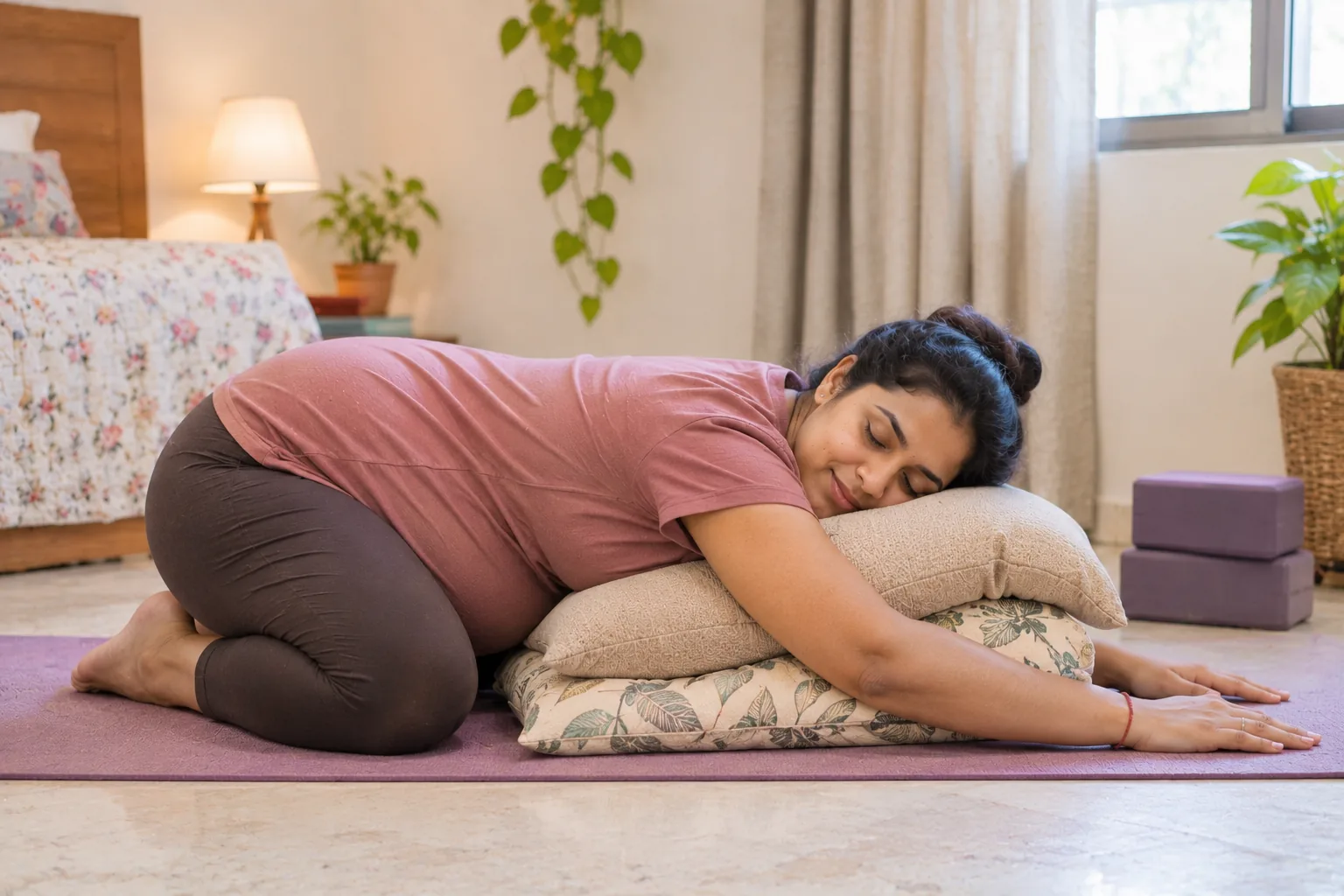
8. Wide-legged child's pose (2 minutes)
Kneel with your knees wide, then fold forward onto a stack of pillows. Rest your head and let your back soften.
9. Side-lying rest (3 minutes)
Lie on your left side with a pillow under your head, one between your knees and one under your bump. Close your eyes and breathe slowly.
You may also like our guide: Pregnancy Yoga Poses
Adjusting the routine for each trimester
| Trimester | What to change |
|---|---|
| First | Keep it short on tired or nauseous days. Skip standing poses if you feel dizzy and do more breathing. Avoid overheating |
| Second | Good time to build the full routine. From about 16 to 20 weeks, rest on your side or propped up instead of flat on your back |
| Third | Shorten your stance in standing poses, use the chair for every balance pose and add more breathing and hip openers |
Best time to do pregnancy yoga at home
Pick the time you feel most awake and comfortable. For many women that is mid-morning or early evening. Wait 1 to 2 hours after a main meal, and avoid the hottest part of the day in summer. A short practice before bed, mostly breathing and the side-lying rest, can help with sleep.
Is pregnancy yoga at home safe?
Yoga adapted for your stage of pregnancy is considered safe for most women. Tommy's, the UK pregnancy charity, points to research showing pregnancy yoga can lower stress hormone levels and anxiety. Home practice stays safe when you:
- Move slowly, especially in poses that need balance, since your centre of gravity shifts as your bump grows
- Choose gentle styles like Hatha, and avoid hot yoga or a heated room
- Skip deep twists, strong backbends, belly-down poses and inversions
- Stretch only to about 70% of your range, because pregnancy hormones make it easy to overstretch
- Use free videos from trusted sources, or join a live class where a teacher can check your form
Stop and call your doctor if you notice
- Vaginal bleeding or fluid leaking
- Regular, painful contractions
- Dizziness, chest pain or a bad headache
- Pain or swelling in one calf
- Your baby moving less than usual
Related reads you may find helpful
Frequently asked questions
Everything you need to know
Practise at Home, With Someone Watching Your Form
fitnoa's live prenatal yoga classes give you the comfort of home with an instructor who adapts every pose to your trimester. Our AI flags posture issues to your instructor in real time, and Private Mode means only your trainer can see you. Book your free trial session.