
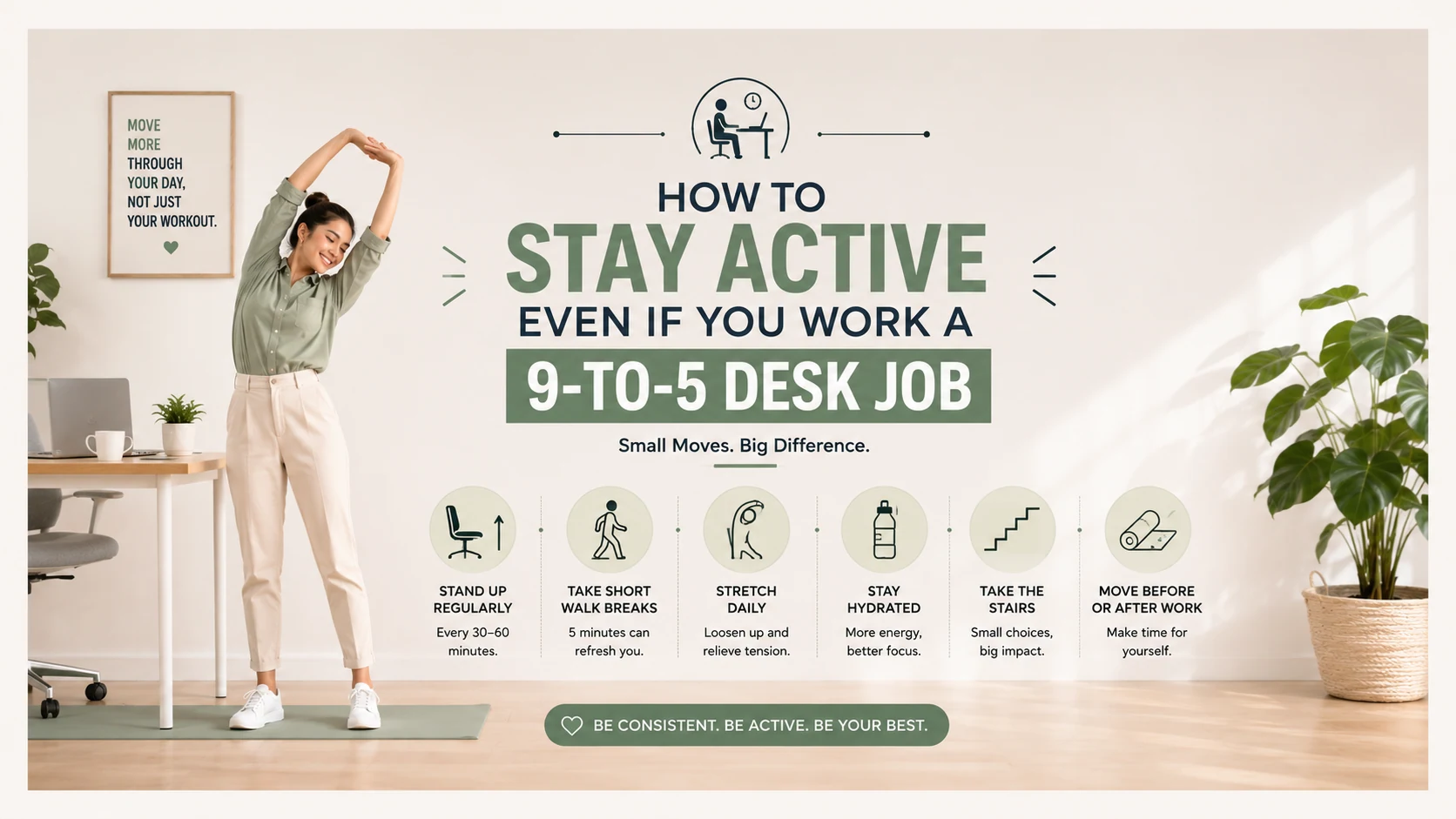
How to Stay Active Even If You Work a 9-to-5 Desk Job
"I just don't have time to exercise." If you work a 9-to-5 desk job, you have probably said this, or at least thought it, more times than you would like to admit.
Here is some genuinely good news: staying active with a full-time desk job is not about finding two free hours you do not have. It is about restructuring small parts of a day you already have, in ways that add up to real fitness over time.
This article walks through exactly how to do that, with specific, realistic strategies rather than vague advice like "just move more."
Why Staying Active Is Harder With a Desk Job, Not Just Less Convenient
It helps to first understand why this feels so difficult, because the reasons are not really about laziness or lack of willpower.
Decision fatigue by evening. After a full day of meetings, emails, and screen-focused work, your mental energy for making one more decision, like whether to go to the gym, is genuinely depleted. This is a real cognitive phenomenon, not an excuse.
Commute time eats into free hours. In many Indian cities, commute times of 45 minutes to over an hour each way are common, which can quietly consume 2 hours a day that might otherwise go toward activity.
Sitting reduces the urge to move. The body adapts to inactivity. The less you move during the day, the less natural urge you feel to move later, which is part of why an entire evening can pass with no real physical activity at all. Learn more in Sitting All Day.
Social and family time competes for the same hours. Especially for people balancing family responsibilities, the evening hours after work are rarely fully free, making a long, dedicated workout session unrealistic most days.
Understanding these real barriers matters because the solution is not "try harder." It is building activity into the structure of the day so it does not depend on leftover willpower at 7 PM.
The Three-Layer Approach to Staying Active With a Desk Job
Rather than relying on one big workout, the most sustainable approach layers activity across three levels of your day.
Layer 1: Background Movement (Throughout the Day)
This is movement that happens without needing dedicated time, woven into work itself.
- Taking calls while standing or pacing
- Walking to a colleague's desk instead of messaging
- Using stairs instead of the lift for a few floors
- Parking slightly farther from the office entrance
- Standing during short breaks rather than reaching for your phone while seated
None of these require a time slot. They simply replace a sedentary default with an active one.
Layer 2: Micro-Workouts (5 to 10 Minutes, Multiple Times a Day)
These are short, structured bursts, like the kind covered in detail in our desk workout guide, done two to four times during work hours. They restart circulation, reduce stiffness, and meaningfully improve blood sugar control between meals.
Layer 3: Structured Exercise (3 to 5 Times a Week)
This is dedicated, focused exercise time, whether early morning, during lunch, or evening, lasting 30 to 45 minutes. This layer is what builds real strength, cardiovascular fitness, and long-term health improvement. Layers 1 and 2 support this layer; they do not replace it.
The mistake many people make is trying to rely only on Layer 3, which is the hardest layer to fit into a busy schedule, while ignoring Layers 1 and 2, which require far less time and willpower.
Best Times to Exercise With a 9-to-5 Job
There is no single "best" time that works for everyone, but each option has clear trade-offs worth knowing.
| Time Slot | Pros | Cons |
|---|---|---|
| Early morning (before work) | Consistent, rarely disrupted by work demands, boosts energy for the day | Requires waking up earlier, harder in winter months |
| Lunch break | Breaks up the sedentary stretch of the day, refreshes focus for the afternoon | Limited time, may need quick changing facilities |
| Evening (after work) | More flexible duration, can be social | Most likely to get cancelled due to fatigue or last-minute plans |
| Late evening | Works for night owls, less rushed | Can affect sleep quality if too intense too close to bedtime |
For most desk workers, morning sessions tend to have the highest long-term consistency, simply because they happen before the day's unpredictability sets in. However, the best time is genuinely the one you can realistically stick to most days, not the theoretically ideal one you keep missing.
How to Build a Sustainable Weekly Activity Routine
Here is a realistic sample structure for someone working a standard 9-to-5 job, balancing all three layers discussed earlier.
- Monday, Wednesday, Friday: 30 to 40 minute structured workout (strength or cardio) before or after work
- Tuesday, Thursday: 15 to 20 minute lighter movement session, like mobility or yoga, plus 2 to 3 micro-workout breaks during the day
- Saturday: Longer activity, such as a structured workout, a sport, or a long walk
- Sunday: Active rest, like a leisurely walk or light stretching
- Every weekday: Background movement habits (stairs, standing calls, short walks) layered throughout
This kind of structure does not demand perfection. Missing one structured session in a week is not a failure if the background and micro-movement layers are still in place.
Important: A few missed days do not erase weeks of progress. Treating a missed week as a reason to quit entirely is the most common reason people abandon fitness routines altogether.
India Specific Realities That Affect Activity Levels
A few factors specific to working life in India deserve honest attention, since generic global fitness advice often does not account for them.
Long, unpredictable commutes. In major Indian cities, traffic and commute times can vary wildly day to day, making it hard to plan a consistent post-work workout time. Building flexibility into your weekly routine, rather than relying on a single fixed slot, tends to work better given this unpredictability.
Extreme heat and humidity for much of the year. Outdoor activity, like a walk or jog, can be genuinely uncomfortable or even risky during peak summer months in many parts of the country. Indoor, climate-controlled options, including live online sessions you can do from home, become especially valuable during these months.
Joint family living and household responsibilities. Many Indian professionals, particularly women, return from a 9-to-5 job to a second set of household and caregiving responsibilities, leaving genuinely little discretionary time in the evening. For this group, morning sessions or very short, high-value movement breaks during work hours often matter more than evening workout plans that consistently get deprioritised. See Women's Home Workouts.
Workplace culture around long hours. It remains common in many Indian corporate environments for the workday to extend well beyond a strict 9-to-5, especially in IT, consulting, and client-facing roles. This makes background movement and micro-workouts, covered as Layers 1 and 2 earlier, especially important, since they do not depend on a fixed end time to the workday.
Acknowledging these realities is not about making excuses. It is about building a plan that actually fits the life you have, rather than one borrowed from a context with shorter commutes, milder weather, or fewer competing responsibilities.
How to Stay Active When Work Gets Genuinely Busy
Even the best routine breaks during high-pressure weeks, deadlines, or travel. Here is how to protect your activity levels without burning out trying to maintain a perfect schedule.
Point 1: Shrink, don't skip. If you cannot do 40 minutes, do 10. Something is almost always better than nothing, and it preserves the habit itself. Point 2: Protect Layer 1 and 2 even when Layer 3 falls apart. Background movement and micro-workouts take far less time and willpower, making them the most realistic fallback during busy stretches. Point 3: Use travel and commute creatively. Walking part of your commute, or doing a short routine in a hotel room while travelling for work, keeps the habit alive even when your normal setup is unavailable. Point 4: Reset without guilt. A few missed days do not erase weeks of progress. Treating a missed week as a reason to quit entirely is the most common reason people abandon fitness routines altogether.
Related reading: stretches that undo hours of sitting.
Common Mistakes Desk Workers Make When Trying to Stay Active
- Going from zero to an intense daily routine overnight. This often leads to burnout or injury within the first two weeks. Building gradually leads to far better long-term consistency.
- Ignoring nutrition while focusing only on exercise. Desk job schedules often come with irregular eating patterns, like skipped breakfasts or late, heavy dinners, which can undo a lot of the benefit from exercise alone. Read more in Diet and Fitness.
- Comparing your routine to someone with a different schedule. Someone without a long commute or family responsibilities may have very different available time. Comparing yourself to them is rarely useful or fair.
- Treating weekends as entirely "off." Some light activity on weekends helps maintain momentum, rather than a hard stop followed by restarting motivation on Monday.
- Choosing workouts you do not actually enjoy. Activity you dread is activity you will eventually quit. Finding a format, whether that is yoga, strength training, or cardio, that you genuinely look forward to dramatically improves consistency. Compare formats in Yoga vs Gym.
How fitnoa Helps You Stay Active Despite a Busy 9-to-5 Schedule
A desk job does not need to mean an inactive life, but it does need a system that works with a busy schedule rather than fighting against it.
Live Fitness Sessions Across Multiple Formats
fitnoa's live fitness sessions, covering yoga, cardio, strength training, and bodyweight exercises, give you structured options across different formats, which is useful for Layer 3 of your routine, since variety helps prevent boredom and supports different goals on different days, depending on your energy and time available.
Live Trainer Guidance
Because sessions are live with real trainers providing guidance throughout, they offer a level of accountability that recorded videos do not, which matters significantly for people managing a demanding job, where the temptation to skip a session is highest exactly when accountability matters most.
AI Posture Tracking and Rep Counting
The AI posture tracking and real-time rep counting also mean you get genuine feedback on whether you are doing exercises correctly, even in a quick session squeezed between meetings, rather than guessing at form alone.
Goal-Based Programs and Nutrition Support
For people whose desk job has led to specific goals, like needing to lose weight, manage diabetes, or simply rebuild general fitness after a long sedentary stretch, fitnoa's goal-based programs combine structured workouts with personalised nutrition support, addressing the layer that exercise alone, as mentioned earlier, often cannot fix by itself.
Detailed Fitness Reports
Your detailed fitness report after every session, covering accuracy, performance, calories burned, and reps completed, also gives you a simple way to track whether your Layer 3 sessions are genuinely improving over weeks, which is motivating in a way that vague effort alone rarely is.
To put this into practice with live expert guidance, explore fitnoa's yoga and holistic wellness program.
Key Takeaways
- Staying active with a 9-to-5 job works best through three layers: background movement, micro-workouts, and structured exercise.
- There is no single best time to exercise; consistency matters more than timing, though mornings tend to have higher long-term adherence for many desk workers.
- During busy weeks, protecting smaller activity layers matters more than forcing a full structured workout.
- Comparing your routine to people with different schedules or responsibilities is rarely fair or useful.
- Structured, accountable support, like live guided sessions, helps maintain consistency during the exact weeks willpower alone tends to fail.
Related reads you may find helpful
Frequently asked questions
Everything you need to know
Make Movement Part of Your 9-to-5, Not a Battle Against It
Staying active with a full-time job gets easier with structure and accountability. fitnoa's live sessions fit into the time you actually have, with real trainers and AI feedback to keep you consistent.