
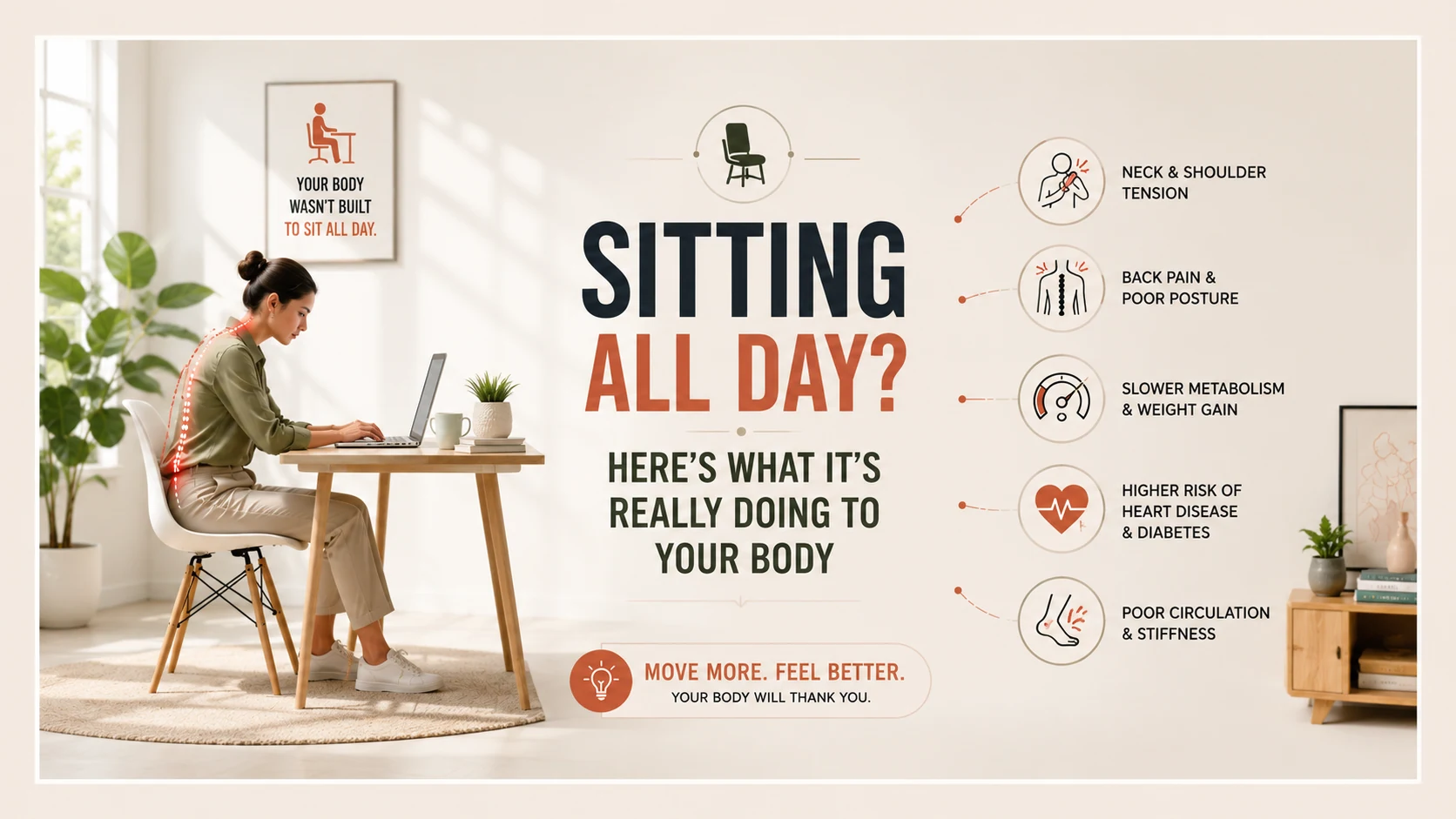
Sitting All Day? Here's What It's Really Doing to Your Body
If you have ever stood up after a long day at your desk and felt your lower back groan in protest, you already know that sitting all day does not feel great. But what is actually happening inside your body during those eight, nine, or even ten hours in the chair?
This is not just about posture or a stiff neck. Prolonged sitting changes how your muscles work, how your blood moves, how your body burns fat, and even how your brain functions. The good news is that once you understand exactly what is going on, you can take small, practical steps to reverse most of the damage, without quitting your job or buying expensive equipment.
Let us break down what science actually says about sitting all day, and what you can realistically do about it.
What Happens to Your Body When You Sit for Hours
When you sit, your body shifts into an almost dormant state. Several systems slow down at the same time.
Your muscles stop working. The big muscles in your legs and glutes, which are responsible for helping pump blood back to your heart, go quiet. This is why your legs can feel heavy or swollen by evening.
Your metabolism slows down. Standing and walking, even gently, keep certain fat-burning enzymes active. Sitting switches them off almost immediately. Some research has found that enzyme activity related to fat breakdown can drop by as much as 90 percent during prolonged sitting.
Blood sugar control gets worse. Muscle contraction helps pull glucose out of your bloodstream. Without movement, your blood sugar stays elevated for longer after meals, which over time increases the risk of insulin resistance. Learn more in our piece on Yoga and Blood Sugar.
Your spine takes on uneven pressure. Sitting, especially with a rounded back, increases pressure on the discs in your lower spine compared to standing. This is a major reason behind chronic lower back pain in office workers.
Your circulation slows. Reduced blood flow in the legs over long periods is linked to a higher risk of blood clots, particularly during very long uninterrupted sitting spells, such as long flights or marathon desk sessions.
Is Sitting Really "The New Smoking"?
You have probably seen this phrase somewhere online. It is catchy, but is it accurate?
The comparison comes from research showing that high amounts of sedentary time are linked with a higher risk of early death, similar in scale to other major lifestyle risk factors. However, unlike smoking, sitting is not toxic in the same direct biochemical sense. The real issue is what sitting replaces: movement.
So while "sitting is the new smoking" is a bit of an exaggeration, the underlying point holds up. Long, unbroken hours of sitting carry real health risks, and most of these risks can be reduced significantly with regular movement breaks, even without becoming an athlete.
How Many Hours of Sitting Is Considered Dangerous?
There is no single magic number, but most research points to a similar pattern.
| Daily Sitting Time | Risk Level | Notes |
|---|---|---|
| Less than 4 hours | Low risk | Typical of active jobs |
| 4 to 8 hours | Moderate risk | Common for most desk workers |
| 8 to 11 hours | High risk | Risk of heart disease and early death rises noticeably |
| 11+ hours | Very high risk | Strongly linked to metabolic and cardiovascular issues |
What matters even more than the total number of hours is how the sitting is broken up. Sitting for 10 hours with movement breaks every 30 minutes is very different from sitting for 10 hours straight without standing once.
The Specific Health Risks of Prolonged Sitting
1. Weight Gain and Belly Fat
Sitting burns very few calories compared to standing or walking. Over weeks and months, this adds up. Many office workers notice fat accumulating specifically around the belly, which is also the type of fat most strongly linked to metabolic problems. Read more in Yoga for Belly Fat Reduction.
2. Lower Back and Neck Pain
Sitting for long hours, especially while leaning toward a screen, puts strain on your lower back, shoulders, and neck. Many people develop a posture where the head juts forward, the shoulders round, and the lower back loses its natural curve. Over months, this can lead to chronic pain that does not go away with a quick stretch.
Important: Sitting still with perfect posture for 8 hours is still sitting. Posture alone will not undo the effects of prolonged inactivity.
3. Increased Risk of Type 2 Diabetes
Because muscle contraction helps regulate blood sugar, long sitting periods without movement are associated with poorer blood sugar control. This is one reason desk workers, even those who exercise in the morning, can still show signs of insulin resistance over time. See Diabetes Fitness for more.
4. Heart Disease Risk
Multiple large studies have linked high sedentary time with a greater risk of cardiovascular disease, independent of how much someone exercises. This is sometimes called the "active couch potato" effect, where someone works out for 30 minutes but is sedentary for the other 23.5 hours of the day.
5. Mental Fatigue and Mood Dips
Sitting reduces blood flow and oxygen delivery to the brain slightly compared to standing or light movement. Many people report feeling mentally foggy or low in energy after long unbroken sitting stretches, which often gets mistaken for tiredness rather than a simple lack of circulation.
Related reading: how long sitting affects metabolic health.
Can Exercise Undo the Damage of Sitting All Day?
This is one of the most searched questions on this topic, and the honest answer is: partially, but not completely.
Exercising for 30 to 60 minutes a day is excellent for your heart, muscles, and mental health. However, research increasingly shows that exercise and sedentary behaviour are two separate risk factors. Someone who works out hard in the morning but then sits for 10 hours straight can still carry meaningful health risks from that sitting time.
Think of it like brushing your teeth once really well in the morning but never again for the rest of the day. It helps, but it does not cancel out everything that happens later.
The better approach is combining regular exercise with frequent movement breaks throughout the day. Even two minutes of walking every 30 minutes has been shown in studies to meaningfully improve blood sugar response after meals. Compare approaches in Yoga vs Gym.
India Specific Context: Why This Matters Even More for Indian Office Workers
The rise of long sitting hours is a particularly fast-moving problem in urban India. With the rapid growth of IT, BPO, and corporate jobs, millions of Indians now spend their entire working life in a chair, often combined with long commutes by car, bus, or metro that add even more sedentary hours before and after work.
There is also a relevant biological angle here. Research has repeatedly shown that Indians tend to develop insulin resistance and central fat accumulation at lower body weights compared to many Western populations, a pattern sometimes called the "thin-fat Indian" phenotype. This means the metabolic harm of long sitting hours can show up earlier and more significantly for Indian office workers than it might for someone with a similar lifestyle elsewhere.
On top of this, traditional Indian meals, especially at lunch, often lean heavily toward refined carbohydrates like white rice, naan, or parathas, with comparatively less protein and fibre. Combined with hours of sitting right after the meal, this is a pattern that can meaningfully worsen blood sugar control over time. Learn more about this in our guide on Hormonal Health.
What Doctors and Fitness Experts Actually Recommend
Physiotherapists commonly point out that the body is not designed to hold any single position, sitting included, for extended, unbroken periods. Joints rely on regular movement to stay lubricated through synovial fluid circulation, and muscles rely on regular use to maintain strength and flexibility. A physiotherapist evaluating someone with chronic lower back pain from a desk job will almost always ask about sitting patterns before assuming the issue is purely structural.
From a metabolic standpoint, many endocrinologists now emphasise "movement throughout the day" as a distinct pillar of diabetes prevention, separate from formal exercise. This reflects the growing understanding that sedentary time and exercise are two different risk factors rather than one cancelling out the other.
The consistent expert recommendation across physiotherapy and metabolic health fields is the same: break up sitting time frequently, build strength in the muscles weakened by prolonged sitting, and treat daily movement as a non-negotiable part of health, not an optional extra reserved for after work.
Common Mistakes People Make While Trying to Fix This
- Only focusing on posture, not movement. Sitting perfectly still with great posture for 8 hours is still sitting. Movement matters more than posture alone.
- Relying only on a standing desk. Standing in one position for hours brings its own issues like knee and lower back strain. Standing needs to be combined with movement, not just a position swap.
- Waiting for a "free hour" to exercise. Most office workers never find that perfect free hour. Short, scattered movement throughout the day works better than waiting for one long session that rarely happens.
- Ignoring hydration. Dehydration makes muscles stiffer and increases the discomfort of long sitting. Many people mistake sitting fatigue for tiredness when it is partly dehydration.
- Skipping warm-ups before stretching. Stretching cold muscles after hours of sitting can sometimes cause strain. A few seconds of gentle movement before stretching helps.
Practical Ways to Counter the Effects of Sitting
Point 1: Set a movement alarm every 30 minutes. Even standing up and walking to get water counts. Point 2: Use the 20-8-2 rule. For every 30 minutes, aim for roughly 20 minutes sitting, 8 minutes standing, and 2 minutes light movement. Point 3: Take phone calls standing up. This alone can remove a surprising number of sitting minutes from your day. Point 4: Choose stairs over the lift when possible. It is a small choice that adds genuine movement across the day. Point 5: Do a short structured workout instead of random stretching. A guided session ensures you are actually moving enough, not just shifting position. See Strength Training for ideas. Point 6: Set your desk water bottle slightly out of reach. This naturally forces you to get up more often.
Related reading: stretches that undo hours of sitting and staying active with a desk job.
How fitnoa Can Help You Counter the Effects of Sitting All Day
Knowing that sitting is harmful is one thing. Actually doing something consistent about it, every single day, is the harder part. This is where having structure and accountability makes a real difference.
Live Fitness Sessions
fitnoa's live fitness sessions give you a fixed point in your day dedicated to movement, guided by a real trainer rather than a generic video you might skip halfway through. This consistency is often what separates people who fix their sitting problem from people who keep meaning to.
AI Posture Tracking
The AI posture tracking feature is particularly useful for desk workers, since it gives real-time feedback on your form during exercises, helping correct the same rounded shoulders and forward head position that hours of sitting create in the first place. Related: Workout Form.
Live Trainer Guidance
Because sessions are live, trainers can adjust the workout in the moment if you mention stiffness in your back or neck, something a recorded video can never do.
Detailed Fitness Reports
After each session, your fitness report shows performance, accuracy, calories burned, and reps completed. Over weeks, this report becomes a simple way to track whether your daily movement is actually increasing, which matters more for desk workers than any single workout.
Goal-Based Programs and Nutrition Support
For those whose sitting habit has already led to noticeable weight gain or early signs of blood sugar issues, fitnoa's goal-based programs for weight loss and diabetes management combine structured workouts with personalised nutrition support, addressing both sides of the problem rather than just one.
Privacy Mode During Group Sessions
And for office workers who feel uneasy exercising on camera around strangers, the privacy mode in group sessions means only you and the trainer can see each other, which removes a common barrier that stops many people from starting in the first place.
Key Takeaways
- Sitting for long hours slows your metabolism, weakens circulation, and increases strain on your spine.
- More than 8 hours of daily sitting is linked to higher risk of heart disease, diabetes, and early mortality.
- Exercise alone does not fully cancel out the effects of prolonged sitting; movement breaks throughout the day matter just as much.
- Small, frequent movement, like a 2 minute walk every 30 minutes, can meaningfully improve blood sugar and circulation.
- Structured support, like guided live sessions and posture tracking, helps build the consistency that random stretching usually fails to deliver.
Related reads you may find helpful
- How Yoga Affects Blood Sugar: Science & Benefits
- Yoga for Belly Fat Reduction: What Actually Works (India Guide)
- Best Home Workouts for Diabetes Management: A Science-Backed Guide
- Strength Training for Beginners at Home: Complete Guide (No Gym Needed)
- Wrong Form is Killing Your Results: Here's How to Fix It at Home
Frequently asked questions
Everything you need to know
Tired of Sitting All Day? Start Moving With fitnoa
Break the cycle of long, unbroken sitting with structured live sessions designed to fit into your workday. fitnoa's trainers and AI posture tracking help you build the movement habits that random stretching alone never delivers.