
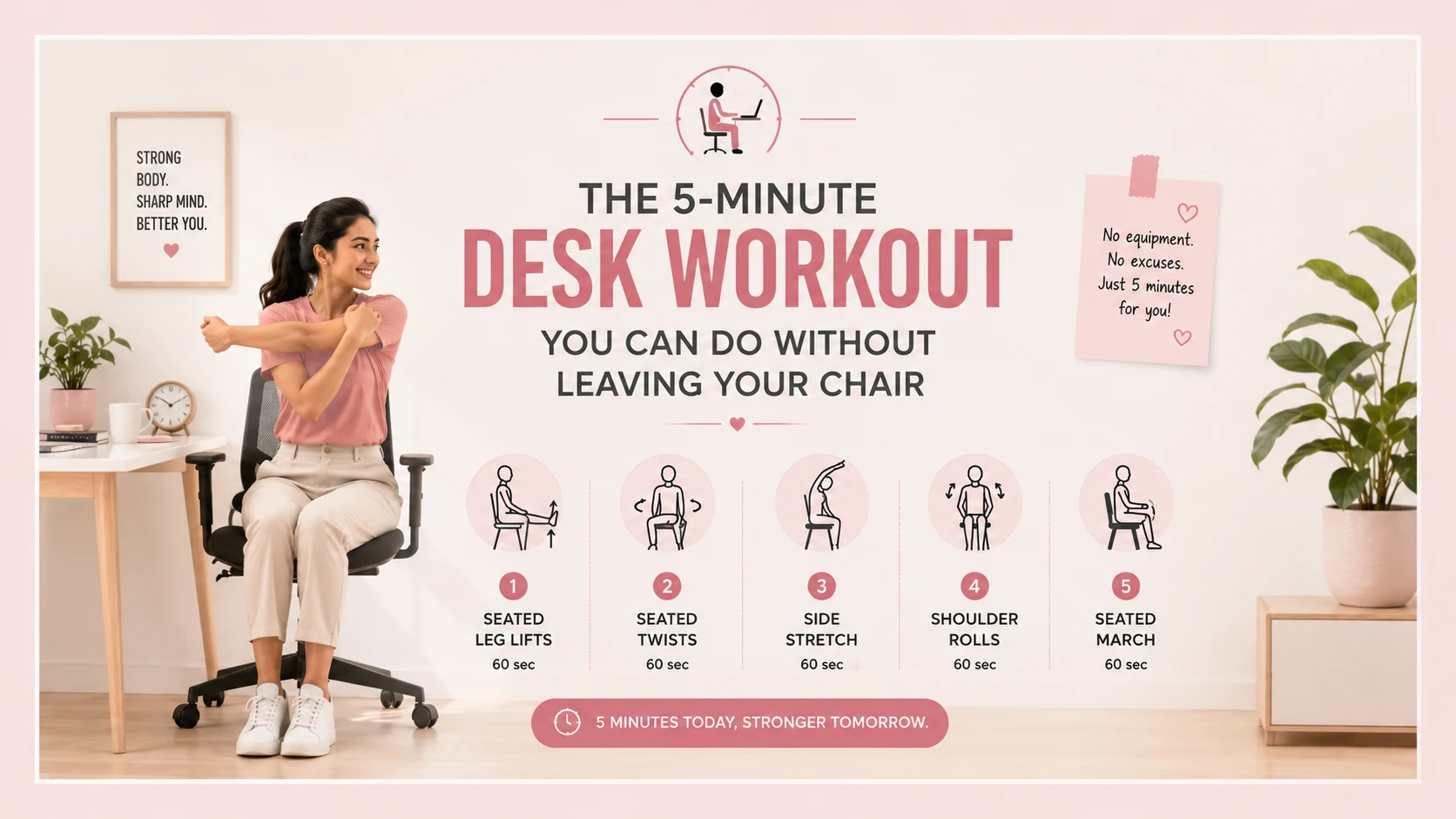
The 5-Minute Desk Workout You Can Do Without Leaving Your Chair
It is 3 PM. Your eyes are tired, your shoulders feel like they have crept up to your ears, and the thought of getting up to "exercise" feels impossible when there are still four meetings left on your calendar.
Here is something that might surprise you: you do not need a gym, a yoga mat, or even five free minutes outside your workday to do something meaningful for your body. You just need your chair.
This article gives you a complete, practical 5-minute desk workout you can do right where you are sitting, plus the reasoning behind why each move matters. No equipment, no changing clothes, no judgment from coworkers walking past.
Why a 5-Minute Desk Workout Actually Works
It might seem like five minutes is too short to matter. But here is the science behind why it does.
When you have been sitting for an hour or more, your blood flow to your legs slows down, your muscles stiffen in fixed positions, and your posture muscles, particularly in your upper back, get switched off. A short burst of movement does three important things almost immediately:
- It restarts blood circulation in your legs and lower body.
- It reactivates muscles that have gone idle, especially in your glutes and upper back.
- It interrupts the mental fog that builds up during long, unbroken focus sessions.
Research on "exercise snacking," meaning short bursts of activity spread through the day, has shown that frequent brief movement can improve blood sugar control and energy levels just as effectively, sometimes more effectively, than one long workout done after a full day of sitting still. Learn more in Yoga and Blood Sugar.
In short, five minutes done three or four times a day adds up to real, measurable benefit. It is not a replacement for proper exercise, but it is far from useless.
You may also like our guide on what sitting all day does to your body.
The Complete 5-Minute Desk Workout
This routine needs no equipment and can be done in office clothes. Each move targets the areas that suffer most from prolonged sitting: hips, lower back, shoulders, neck, and circulation in the legs.
Minute 1: Seated Marching
Sit tall, hold the edges of your chair for support, and lift one knee toward your chest, then lower it and switch to the other leg. Continue alternating for one minute.
This wakes up your hip flexors, which tighten significantly from sitting, and gets blood moving through your legs quickly.
Minute 2: Seated Spinal Twist
Sit tall with your feet flat on the floor. Place your right hand on the back of your chair and your left hand on your right knee. Gently twist your torso to the right, hold for a few seconds, then switch sides. Repeat for one minute.
This move counters the forward-rounding posture that builds up from typing and screen use, while gently mobilising the spine.
Minute 3: Shoulder Rolls and Chest Opener
Roll your shoulders backward in slow, big circles for 20 seconds. Then clasp your hands behind your back, straighten your arms, and gently lift your chest for 20 seconds. Repeat the sequence for the full minute.
This directly targets the rounded shoulder posture caused by hours of typing and reaching for a mouse. See Workout Form for more on why correct form matters.
Minute 4: Seated Leg Extensions
Sit tall, extend one leg straight out in front of you, hold for two seconds, then lower it and switch legs. Continue alternating for one minute.
This activates the quadriceps, which weaken from disuse during long sitting periods, and improves blood flow to the lower legs, helping reduce that heavy, swollen feeling by the end of the day.
Minute 5: Neck Release and Wrist Stretch
Gently tilt your head to one side, hold for 15 seconds, then the other side. Follow this with a simple wrist stretch: extend one arm forward, palm up, and gently pull the fingers back with your other hand for 15 seconds, then switch.
This addresses tech neck and the wrist strain that builds up from typing, both extremely common complaints among office workers.
Important: Slow, controlled movement activates muscles far better than rushing through the reps. Quality matters more than speed in this routine.
How Often Should You Do This Desk Workout?
For best results, repeat this 5-minute routine two to four times across your workday, ideally:
- Once mid-morning
- Once right after lunch
- Once mid-afternoon, when the energy dip usually hits
This spacing matters more than doing it once for a longer stretch. Movement spread throughout the day keeps your metabolism more active than one single burst, no matter how intense.
Comparison: 5-Minute Desk Workout vs. a Single Long Workout
| Factor | 5-Minute Desk Workout (multiple times) | One Long Workout Per Day |
|---|---|---|
| Ease of starting | Very high, no preparation needed | Lower, requires dedicated time and space |
| Blood sugar control through the day | Better, due to repeated activation | Limited to a short window after the workout |
| Replaces structured exercise | No | Yes, more complete |
| Best used as | A daily habit between proper workouts | The main exercise of the day |
| Realistic for busy schedules | Very realistic | Often skipped on hectic days |
The honest takeaway here is that these are not competitors. The 5-minute desk workout is what keeps your body active between your real workouts, not a replacement for structured strength or cardio training. Read more in Yoga vs Gym.
The Science of "Exercise Snacking" Explained Simply
The idea behind this 5-minute desk workout is closely related to a growing area of research called exercise snacking. Instead of asking whether one long workout is better than nothing, researchers have started asking a different question: what if several short bursts of activity, spread across the day, could match or even outperform a single workout done after hours of complete inactivity?
Several studies on this topic have measured outcomes like post-meal blood sugar, perceived energy, and even small improvements in fitness markers over weeks. The general pattern that emerges is encouraging for busy professionals: short, frequent bouts of movement, even just a few minutes long, produce real, measurable physiological responses, including improved glucose uptake by muscles and better circulation, without requiring a shower, a change of clothes, or a block of free time most office workers simply do not have during work hours.
This does not mean exercise snacking is equivalent to a structured strength or cardio session in terms of building fitness. What it does mean is that the minutes spent on a 5-minute desk workout are not wasted time. They are doing real, useful physiological work, just at a smaller, more frequent scale.
Adapting This Routine for Different Office Settings
Not every workplace looks the same, and the desk workout above can be adjusted depending on your setup.
Open-plan offices: Stick to the more subtle moves, like seated marches, ankle circles, and gentle neck releases, which draw less visible attention while still delivering benefit.
Private cabins or remote work setups: You have more freedom to do the full routine, including standing chest openers and more visible stretches, without concern about being noticed.
Shared co-working spaces: A short walk to refill water, combined with subtler seated movements at the desk, often works best as a practical middle ground.
The specific setting matters less than consistency. A slightly modified version of this routine done reliably three times a day will always outperform a "perfect" version that only gets done occasionally because it feels awkward in your particular office environment.
Related reading: tech neck and how to fix it.
Common Mistakes With Desk Workouts
Point 1: Doing it too fast. Rushing through the movements reduces the benefit. Slow, controlled motion activates muscles better than quick, sloppy reps. Point 2: Skipping it on busy days. Ironically, the busiest, most sedentary days are exactly when this routine matters most. Point 3: Treating it as a substitute for real exercise. This routine maintains circulation and reduces stiffness, but it will not build strength or significantly improve fitness on its own. See Strength Training for a proper foundation. Point 4: Forgetting to breathe normally. Many people unconsciously hold their breath during stretches, which increases tension instead of releasing it. Point 5: Doing the same move repeatedly and skipping others. Each move in this routine targets a different problem area. Skipping the neck or wrist stretch, for example, leaves tech neck and wrist strain unaddressed.
Related reading: stretches that undo hours of sitting.
Who Should Be Careful With This Routine
If you have an existing back injury, a recent surgery, or a diagnosed joint condition, check with your doctor before starting any new movement routine, even a gentle one like this. Pregnant women should also modify or skip the spinal twist and check with their doctor on safe alternatives, since fitnoa's specialised pregnancy care programs include movement guidance designed specifically for this stage of life. See Is Prenatal Yoga Safe? for more.
How fitnoa Helps You Build This Into a Real Habit
A 5-minute desk workout is simple on paper, but most people forget to actually do it consistently once the workday gets busy. This is the real challenge, not the exercises themselves.
Live Fitness Sessions
fitnoa's live fitness sessions give your day a fixed anchor point for movement, which makes it far easier to also remember smaller breaks like this one, since your mind is already in the habit of treating movement as part of your schedule rather than an afterthought.
AI Posture Tracking
The AI posture tracking feature is especially relevant here, since many of these desk exercises, like the spinal twist and shoulder rolls, depend on correct form to actually help your posture rather than just feeling like motion. Real-time feedback during your structured fitnoa sessions teaches your body the correct alignment, which then carries over naturally into how you do these quick desk breaks too.
Goal-Based Programs and Nutrition Support
For office workers managing specific concerns like early signs of poor metabolic health or weight gain from a sedentary job, fitnoa's goal-based programs combine structured live training with personalised nutrition support, so your 5-minute breaks work alongside a complete plan rather than standing alone.
Detailed Fitness Reports
Your end-of-session fitness reports, which track accuracy, calories burned, and reps completed, also help you notice patterns, for instance whether your energy dips on days you skip movement breaks, which is valuable feedback most people never get to see clearly.
Key Takeaways
- A 5-minute desk workout can restart circulation, reactivate idle muscles, and reduce the mental fog that builds from long sitting.
- The most effective approach is repeating it two to four times across the day, not doing it just once.
- This routine complements, but does not replace, structured exercise like strength training or cardio.
- Slow, controlled movement gives better results than rushing through the exercises.
- Building consistency matters more than the exercises themselves, and structured support like fitnoa's live sessions can help make movement an automatic part of your day.
Related reads you may find helpful
Frequently asked questions
Everything you need to know
Turn Movement Breaks Into a Real Habit With fitnoa
A 5-minute desk workout is a great start, but lasting change comes from consistency. fitnoa's live sessions and AI posture tracking help you build movement into your day so it actually sticks.