
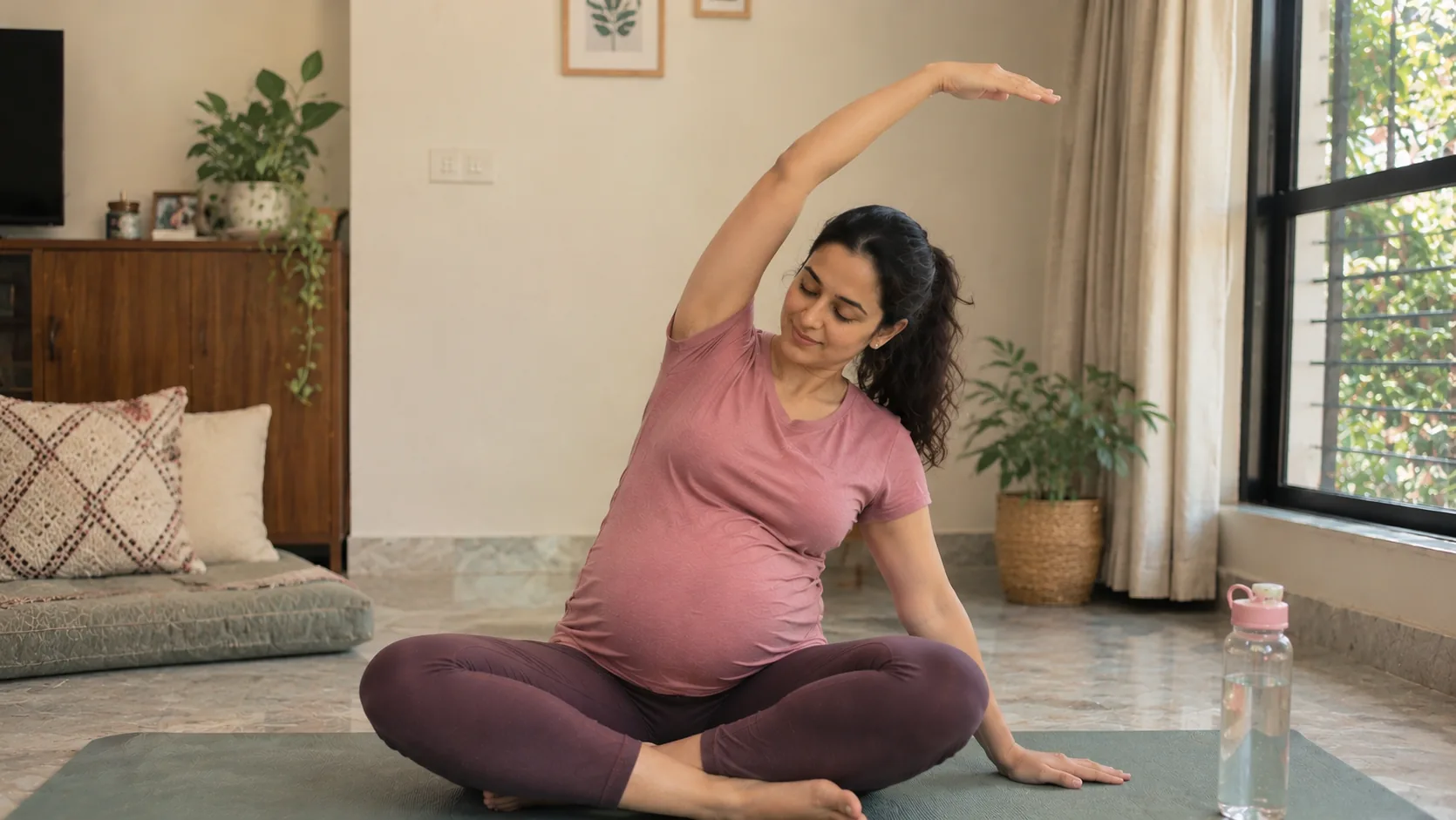
7 Month Pregnancy Exercise for Normal Delivery
In the 7th month, the most useful exercises for a normal delivery are walking, supported squats, pelvic tilts, butterfly pose, birthing ball movements, Kegels and slow breathing practice. If your doctor has cleared you, aim for about 30 minutes on most days of the week. None of these can promise a normal delivery, but women who stay active through pregnancy tend to have fewer C-sections, and these moves build exactly the strength and stamina labour asks for.
By month 7 a lot of mothers start hearing two kinds of advice at once. Your gynaecologist says keep moving. Someone at home says rest as much as you can now. Both come from a caring place, and for most healthy pregnancies the medical guidance is clear that gentle, regular movement is safe and helps.
Important: Check with your doctor before you start or change any exercise routine, especially if you have been told your pregnancy is high risk.
What changes in the 7th month
Month 7 is roughly weeks 27 to 31, the start of the third trimester. Your bump is growing quickly, your centre of gravity has moved forward, and the hormone relaxin is loosening your joints so your pelvis can open during birth.
That combination is why this month calls for slower, steadier exercise. Your joints stretch more easily than usual, so it is easier to overdo a stretch. Balance gets trickier. Back ache and swollen feet are common. The goal now is to stay strong and mobile while keeping everything comfortable.
- Lying flat: the American College of Obstetricians and Gynecologists (ACOG) advises against exercising flat on your back for long stretches at this stage. Lying back can press on a large vein and make you dizzy. Use an incline or side-lying positions instead.
- Heat: exercise in the cooler part of the day, and drink water before and after.
- Effort: you should be able to talk comfortably while you move. If you are too breathless to speak, slow down.
You may also like our guide: Is Prenatal Yoga Safe? Expert Guidelines for Every Trimester
How exercise in the 7th month helps with normal delivery
ACOG recommends about 150 minutes of moderate activity a week for healthy pregnant women, which works out to 30 minutes on five days. It lists a lower chance of a C-section among the benefits, along with less excess weight gain and a lower risk of gestational diabetes and pre-eclampsia.
In practical terms, the 7th month is a good time to work on four things:
- Stamina: labour can go on for hours, and regular walking prepares your heart and lungs for that effort.
- Leg and hip strength: squatting, kneeling and changing positions during labour all lean on your thighs and glutes.
- Pelvic floor control: these muscles need to tighten well and also let go fully when it is time to push.
- Back comfort: a stronger, more mobile back makes the last trimester easier to live with.
7 safe exercises for the 7th month
Start with whichever two or three feel good, then add more as your body settles into them. Keep a chair or wall nearby for anything that needs balance.
1. Walking
Walking is the easiest place to start and the one most women can keep up until the end. Choose a flat path and supportive shoes, and walk at a pace where you can still chat.
- How long: 20 to 30 minutes, five days a week. If you have not been active, start with 10 minutes and add a few minutes each week.
- When: early morning or evening, especially in Indian summers.
- Skip it: on uneven, crowded or slippery ground, where a fall is more likely.
2. Supported squats
Squats strengthen your thighs and glutes and get you used to a position many women find useful in labour.
- How: stand with feet a little wider than your hips, hold the back of a sturdy chair or a kitchen counter, and slowly bend your knees as if you are sitting down. Keep your back long. Come back up slowly.
- How many: 8 to 10, twice a day.
- Go easy: only go as low as feels comfortable. If you have pelvic or pubic bone pain, keep the squat shallow or leave it out and mention it to your doctor.
3. Pelvic tilts (cat-cow)
These are a lifesaver for an aching lower back at the end of the day.
- How: come onto your hands and knees with a folded towel under your knees. Breathe in and let your back stay flat. Breathe out and gently round your lower back up towards the ceiling. Return to flat.
- How many: 10 to 20 slow rounds.
- Good to know: you will often hear that pelvic tilts turn the baby into a better position. A clinical trial on hands-and-knees rocking found it did not change the baby's position at birth. They are still well worth doing for back comfort and a flexible spine.
4. Butterfly pose (Baddha Konasana)
Butterfly pose gently opens the hips and inner thighs, and it is one Indian mothers ask about a lot.
- How: sit on a folded blanket so your hips are slightly raised. Bring the soles of your feet together and let your knees fall out to the sides. Sit tall and breathe slowly. You can move your knees gently up and down.
- How long: 1 to 2 minutes, a few times a day.
- Go easy: your joints are looser this month, so let gravity do the work and avoid pressing your knees down.
5. Birthing ball circles
Sitting on a birthing ball keeps your pelvis moving while you rest, and many women carry this straight into labour.
- How: sit on the ball with your feet flat and wide on the floor. Slowly draw circles with your hips, then rock gently forward and back.
- Ball size: your hips should sit a little higher than your knees.
- How long: 5 to 10 minutes, or whenever you would otherwise sit on the sofa.
6. Kegels (pelvic floor exercises)
Pelvic floor training has some of the strongest evidence of anything here. A Cochrane review found it lowers the chance of leaking urine during and after pregnancy.
- How: squeeze the muscles you would use to stop passing urine, hold for 5 seconds, then let go completely for 5 seconds.
- How many: 10 squeezes, three times a day.
- The part people miss: the full release matters as much as the squeeze. Pushing the baby out needs a pelvic floor that can relax.
7. Slow breathing
This one feels too simple to count, yet it is the exercise you will use most on the day.
- How: sit comfortably, breathe in through your nose for a count of four, and breathe out slowly through your mouth for a count of six.
- How long: 5 minutes a day, ideally before bed.
- Why now: practising it daily makes it easier to fall back on when contractions start.
A simple 7th month routine
You don't need a gym or any special equipment for this. Here is how a normal week can look:
| Day | What to do | Time |
|---|---|---|
| Monday | Walk, then butterfly pose | 30 min |
| Tuesday | Squats, pelvic tilts, ball circles | 20 to 25 min |
| Wednesday | Walk | 30 min |
| Thursday | Prenatal yoga class or video | 30 to 40 min |
| Friday | Walk, then pelvic tilts | 30 min |
| Saturday | Squats, ball circles, butterfly pose | 20 to 25 min |
| Sunday | Rest, or a short easy walk | 10 to 15 min |
Kegels and slow breathing fit in every day, sitting at your desk, while the dal is cooking or lying on your side in bed.
You may also like our guide: Home Workout Plan for Indian Women
Exercises to avoid in the 7th month
These are the activities ACOG, the NHS and our prenatal instructors suggest leaving until after your baby arrives:
- Long stretches lying flat on your back, including some floor workouts and yoga poses
- Anything with a fall risk, like cycling outdoors, skating or exercising on uneven ground
- Contact sports or anything that could knock your bump
- Hot yoga or exercise in a very hot room
- Deep twists, strong backbends and lying on your belly
- Jumping and high-impact moves that strain loose joints and the pelvic floor
When your doctor may ask you to hold off
Some pregnancies need a pause on exercise, at least until your doctor has looked at things closely. These include placenta previa after 26 weeks, pre-eclampsia or high blood pressure in pregnancy, signs of preterm labour, a weak (incompetent) cervix, waters that have broken, and some heart or uncontrolled diabetes conditions. If any of these apply to you, follow your doctor's plan before trying anything in this guide.
Stop and call your doctor if you notice
- Vaginal bleeding or fluid leaking
- Regular, painful contractions
- Dizziness, a headache that won't settle, or chest pain
- Pain or swelling in one calf
- Shortness of breath before you even start
- Weakness that affects your balance
- Your baby moving less than usual
Month 7 is a lovely time to settle into a steady routine. A little movement most days, done comfortably, goes a long way for your body now and on the day you meet your baby.
Related reads you may find helpful
- Is Prenatal Yoga Safe? Expert Guidelines for Every Trimester
- The Only Home Workout Plan Indian Women Actually Stick To (No Equipment Needed)
- Pregnancy Exercise for Normal Delivery: What Helps, Month by Month
- 5 Month Pregnancy Exercise for Normal Delivery: A Gentle Start for the Second Trimester
- 6 Month Pregnancy Exercise for Normal Delivery: Build Strength While You Can
Frequently asked questions
Everything you need to know
Guided Prenatal Exercise from Home
If you would like someone to watch your form as you exercise this month, fitnoa's live prenatal sessions are run by instructors who adjust every move to your trimester, and our posture feedback flags when a pose needs correcting.