
Pregnancy Ball Exercises
Pregnancy ball exercises are gentle moves done while sitting on, or leaning over, a large birthing ball: hip circles, side-to-side sways, gentle bouncing, seated marching, pelvic floor squeezes, wall squats, and kneeling over the ball to rest your back. Most women up to 5 ft 8 in (1.73 m) need a 65 cm ball, and taller women a 75 cm ball. Sit with your hips slightly higher than your knees. You can start in any trimester once your doctor has cleared you for exercise.
A birthing ball is one of the cheapest and most useful things you can buy in pregnancy. It is easier on your back than a sofa, keeps your pelvis moving while you sit, and is a tool many women carry straight into the labour room.
Important: Check with your doctor before starting, especially if you have had bleeding, have placenta previa or have been asked to rest.
Choosing the right ball size
The NHS gives a simple guide:
| Your height | Ball size |
|---|---|
| Up to 5 ft 8 in (1.73 m) | 65 cm |
| Taller than 5 ft 8 in (1.73 m) | 75 cm |
When you sit on it, your knees should be about 10 cm (4 in) lower than your hips. If your knees are higher than your hips, the ball is too small or needs more air.
Look for an anti-burst ball. If it gets a puncture, it deflates slowly instead of popping.
How to sit on a pregnancy ball
- Place the ball on a yoga mat so it doesn't roll.
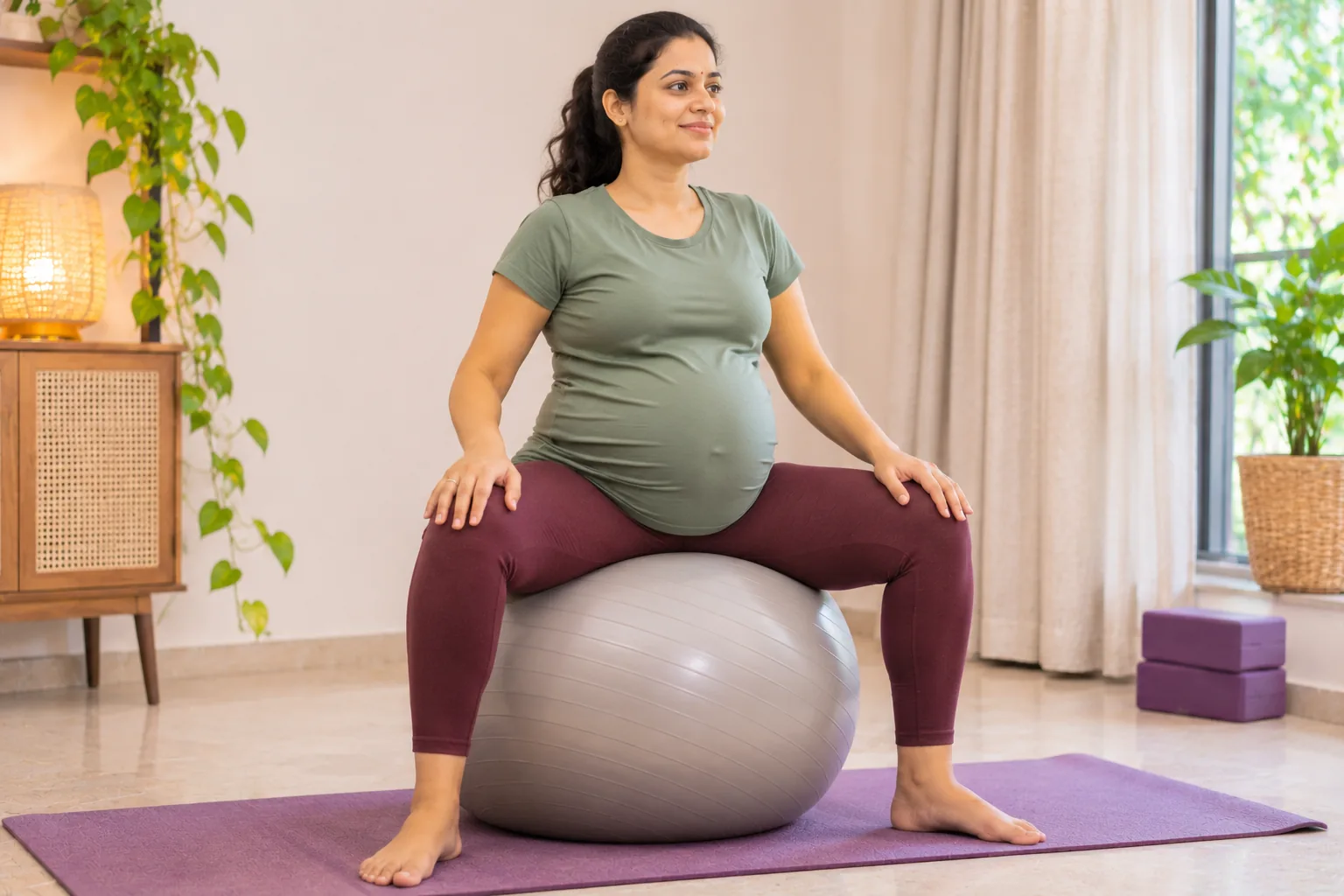
- Sit in the centre of the ball with your feet flat on the floor, wider than your hips.
- Keep your back tall and your weight even on both sit bones.
- Have a wall, a sofa or a person nearby the first few times.
8 pregnancy ball exercises
1. Hip circles
Loosens the hips and lower back.
- Sit tall with feet wide. Slowly draw circles with your hips, 10 one way and 10 the other.
- Trimesters: all.
2. Side-to-side sways
Eases stiffness in the lower back and hips.
- Shift your hips gently left and right, keeping your upper body steady. 1 to 2 minutes.
- Trimesters: all.
3. Pelvic tilts on the ball
Relieves back ache and works the deep tummy muscles.
- Roll your pelvis slightly forward and back, tucking and untucking your tailbone. 10 to 15 times.
- Trimesters: all.
4. Gentle bouncing
Builds pelvic mobility and is soothing on tired days.
- Bounce lightly, keeping both feet on the floor. 1 to 2 minutes.
- Trimesters: second and third. Skip it if you have pelvic or pubic bone pain.
5. Seated marching
A light cardio and balance move.
- Lift one foot a few centimetres, put it down, then the other. 10 to 20 lifts each side.
- Trimesters: first and second. Hold a sofa or wall later on.
6. Pelvic floor squeezes on the ball
Sitting on the ball helps you feel your pelvic floor muscles.
- Squeeze the muscles you'd use to stop passing urine for 5 seconds, then fully let go. The NHS suggests 3 sets of 8 squeezes a day.
- Trimesters: all.
7. Wall squats with the ball
Strengthens your legs and opens the pelvis.
- Place the ball between your lower back and a wall. Feet shoulder-width apart, a little in front of you.
- Slowly roll down the wall until your knees bend towards 90 degrees, then come back up. 8 to 10 times.
- Trimesters: all. Only go as low as feels comfortable.
8. Kneeling lean over the ball
The best rest position for back pain, heartburn or a baby pushing up into your ribs.
- Kneel on a cushion and drape your upper body over the ball.
- Rock gently forward and back, or just rest and breathe. 2 to 5 minutes.
- Trimesters: second and third.
You may also like our guide: 7 Month Pregnancy Exercise for Normal Delivery
When to start using a pregnancy ball
You can sit on a ball and do gentle moves from early pregnancy, as long as your doctor has cleared you for exercise. Many women use it more from the second trimester, swapping it in for a desk chair or sofa. Tommy's midwives suggest getting used to it during pregnancy so it feels safe and familiar if you want to use it in labour.
Benefits of pregnancy ball exercises
- More comfortable sitting than a sofa or desk chair, especially later in pregnancy
- Less back pressure, because your weight spreads more evenly
- Gentle core work as your tummy and back muscles keep you balanced
- Better hip and pelvis mobility
- Practice for labour, where a ball can help you stay upright and ease the pain of contractions
A ball can't induce labour on its own. As one obstetric nurse told The Bump, babies and placentas decide when labour starts.
When to avoid ball exercises
- If you have been told to rest or reduce activity
- If you have pelvic girdle or pubic bone pain (skip bouncing and wide moves)
- If you feel dizzy or your balance is poor that day
- Any exercise lying on your back over the ball after about 16 to 20 weeks
Stop and call your doctor if you notice
- Vaginal bleeding or fluid leaking
- Regular, painful contractions
- Dizziness, chest pain or shortness of breath
- Pelvic pain that doesn't settle
- Your baby moving less than usual
Related reads you may find helpful
Frequently asked questions
Everything you need to know
Learn Ball Work With an Instructor
fitnoa's live prenatal classes include birthing ball sequences matched to your trimester. Our AI watches your posture on the ball and alerts the instructor when your alignment drifts, and Private Mode keeps your video visible only to your trainer. Book your free trial session.