
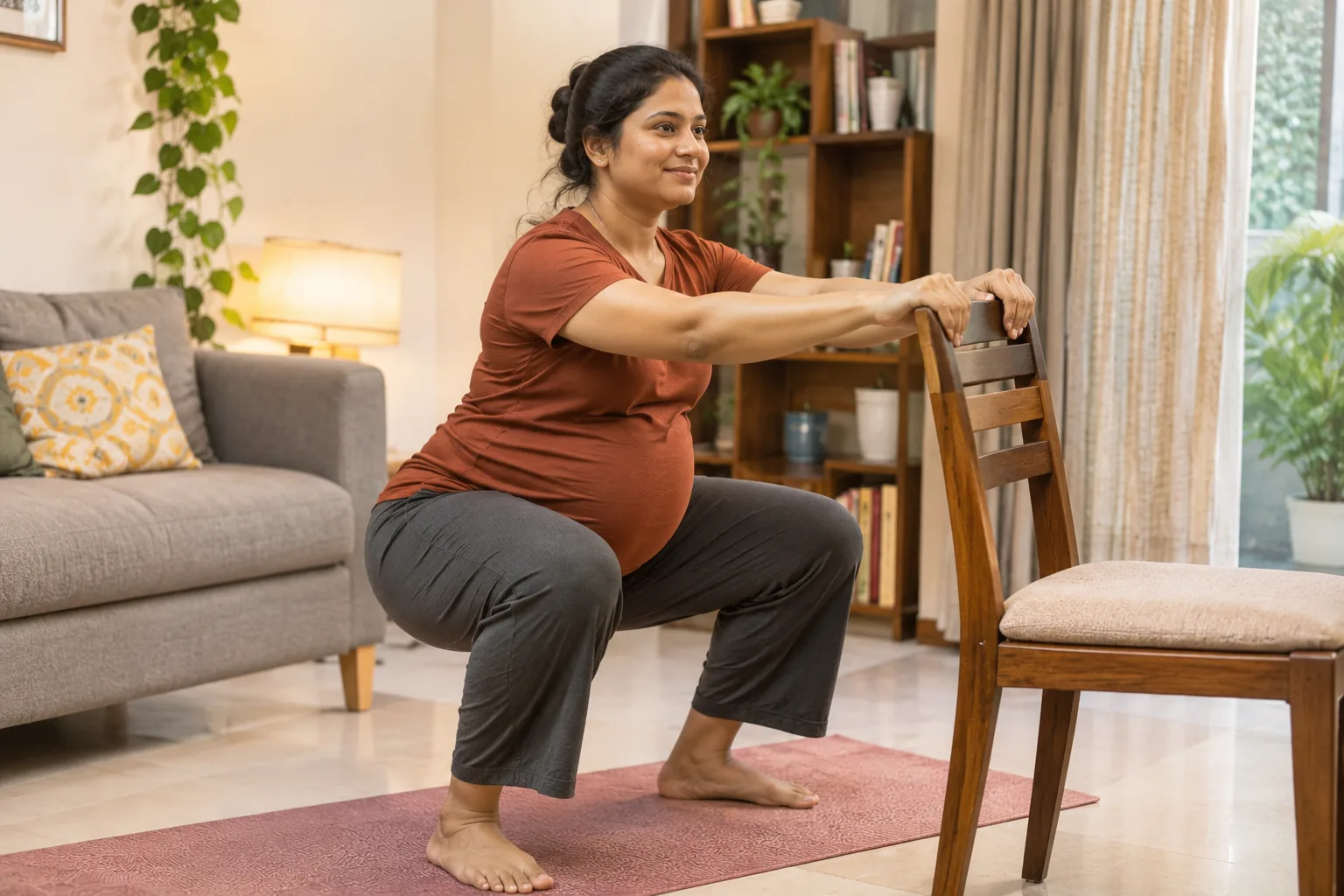
Pregnancy Exercise for Normal Delivery: What Helps, Month by Month
The most useful pregnancy exercises for normal delivery are brisk walking, supported squats, pelvic tilts, butterfly pose, birth ball movements, pelvic floor (Kegel) exercises and breathing practice, done regularly through pregnancy with your doctor's okay. Research links regular moderate exercise, about 150 minutes a week, with shorter labour and a lower chance of an emergency C-section. No exercise can guarantee a normal delivery, but a stronger, more mobile body gives you better odds and an easier recovery.
Almost every pregnant woman in India hears the same advice: walk for 30 minutes. It's good advice, and as Fertilia's research summary puts it, it's also less than half the story. Walking builds stamina. Labour also needs strong legs, a mobile pelvis, a pelvic floor that can both squeeze and relax, and breathing you can control under pressure.
Important: Check with your doctor before starting. If you have a low-lying placenta, cervical problems, high blood pressure, bleeding or a history of preterm labour, you may need a modified plan or rest.
Can normal delivery happen without exercise?
Yes. Many women have a normal delivery without a structured exercise routine, and many fit women need a C-section for reasons that have nothing to do with fitness, like the baby's position or the placenta. Exercise improves the odds, and the outcome still depends on many things.
What it does well, according to the studies Fertilia summarises:
- Shorter active labour. A 2018 study by Barakat and colleagues found that women in a supervised third-trimester exercise programme had a noticeably shorter first stage of labour.
- Fewer emergency C-sections. A 2014 meta-analysis in the British Journal of Sports Medicine found supervised antenatal exercise was linked to a lower risk of caesarean delivery.
- A pelvic floor ready for pushing. A 2018 Cochrane review rated pelvic floor muscle training as the best-supported way to keep these muscles strong in and after pregnancy.
- Lower gestational diabetes risk, which matters because diabetes in pregnancy raises the chance of a larger baby and an assisted or caesarean birth.
Notice the word "supervised" in those studies. The women had someone guiding their form and intensity.
When should I start exercising for normal delivery?
As early as your doctor allows, and ideally from the second trimester at the latest. The physiotherapists at UT Southwestern Medical Center say they'd like to see women right after the first trimester to start pelvic floor work, and Apollo Cradle suggests daily walks from the sixth month, earlier if you can. Starting early gives you months to build strength gradually.
The 7 best exercises for normal delivery
1. Brisk walking
Keeps your heart and lungs fit for labour, and later in pregnancy helps your baby settle lower into the pelvis. Aim for 20 to 30 minutes most days on a flat, safe surface in supportive shoes.
2. Supported squats
Strengthen your thighs and open the pelvis. Mayo Clinic notes that squatting during labour opens the pelvis and gives the baby more room, so practising now makes the position easier later. Hold a chair or slide down a wall with a ball behind your back. 8 to 10 slow reps.
3. Pelvic tilts
On all fours or standing with your back to a wall, gently tuck and untuck your pelvis. They ease back ache and keep your core working. 10 to 15 reps.
4. Butterfly pose
Sit with the soles of your feet together and let your knees drop gently outward, cushions under them if needed. Apollo Cradle calls it safe throughout pregnancy. Hold for a minute or gently flutter the knees.
5. Birth ball movements
Sit tall on a birth ball with feet flat and draw slow hip circles or bounce gently. It helps baby's positioning and takes pressure off your lower back, especially in the last weeks.
6. Kegels (pelvic floor exercises)
Squeeze the muscles you'd use to stop passing urine or wind, hold for a few seconds, then fully relax. The relaxing matters as much as the squeezing, because in the pushing stage your pelvic floor has to let go.
7. Breathing practice
Slow belly breathing and long out-breaths help you stay calm and work with contractions. Avoid forceful breathing like kapalabhati and bhastrika in pregnancy.
You may also like our guide: 7 Month Pregnancy Exercise for Normal Delivery
Exercise for normal delivery, month by month
| Month | Focus |
|---|---|
| 1 to 3 | Gentle walking, pelvic tilts, Kegels, breathing. Rest on tired days. |
| 4 to 5 | Build strength: squats, wall push-ups, side-lying leg lifts, prenatal yoga |
| 6 | Add daily walks, butterfly pose and more hip mobility |
| 7 | Squats, pelvic tilts, birth ball work and breathing for labour |
| 8 | Labour positions, birth ball, gentler squats, more relaxation |
| 9 | Walking, birth ball, supported squats, breathing and rest |
How hard should you exercise?
Moderate. ACOG's guidance, which Fertilia cites, is 150 minutes of moderate activity a week. That's about 30 minutes on five days. You should be a little breathless but still able to talk in full sentences.
The part most home routines miss
Every study above used supervised exercise. That's not a coincidence. In pregnancy your joints loosen and your balance shifts, so a squat with knees caving in or a pelvic tilt that arches your back can do more harm than good. At home, nobody's watching. In a big online class, the teacher usually can't watch everyone either.
fitnoa's live prenatal classes are built around this. An AI follows each person's posture throughout the class and alerts the instructor the moment someone needs a correction, so you get close attention in a group class. Private Mode means only your trainer can see you.
What to avoid
- Lying flat on your back for long after the first trimester
- Crunches, sit-ups and heavy twisting
- Jumping, high-impact moves and contact sports
- Heavy lifting and holding your breath
- Exercising in a hot room or on an empty stomach
Stop and call your doctor if you notice
- Vaginal bleeding or fluid leaking
- Regular, painful contractions before 37 weeks
- Dizziness, chest pain or a severe headache
- Calf pain or swelling
- Your baby moving less than usual
Related reads you may find helpful
Frequently asked questions
Everything you need to know
Prepare for Labour With Someone Watching Your Form
fitnoa's live prenatal classes cover squats, pelvic floor work, hip mobility and breathing for labour, adjusted to your month. Our AI alerts your instructor whenever your posture needs fixing. Book your free trial session.