
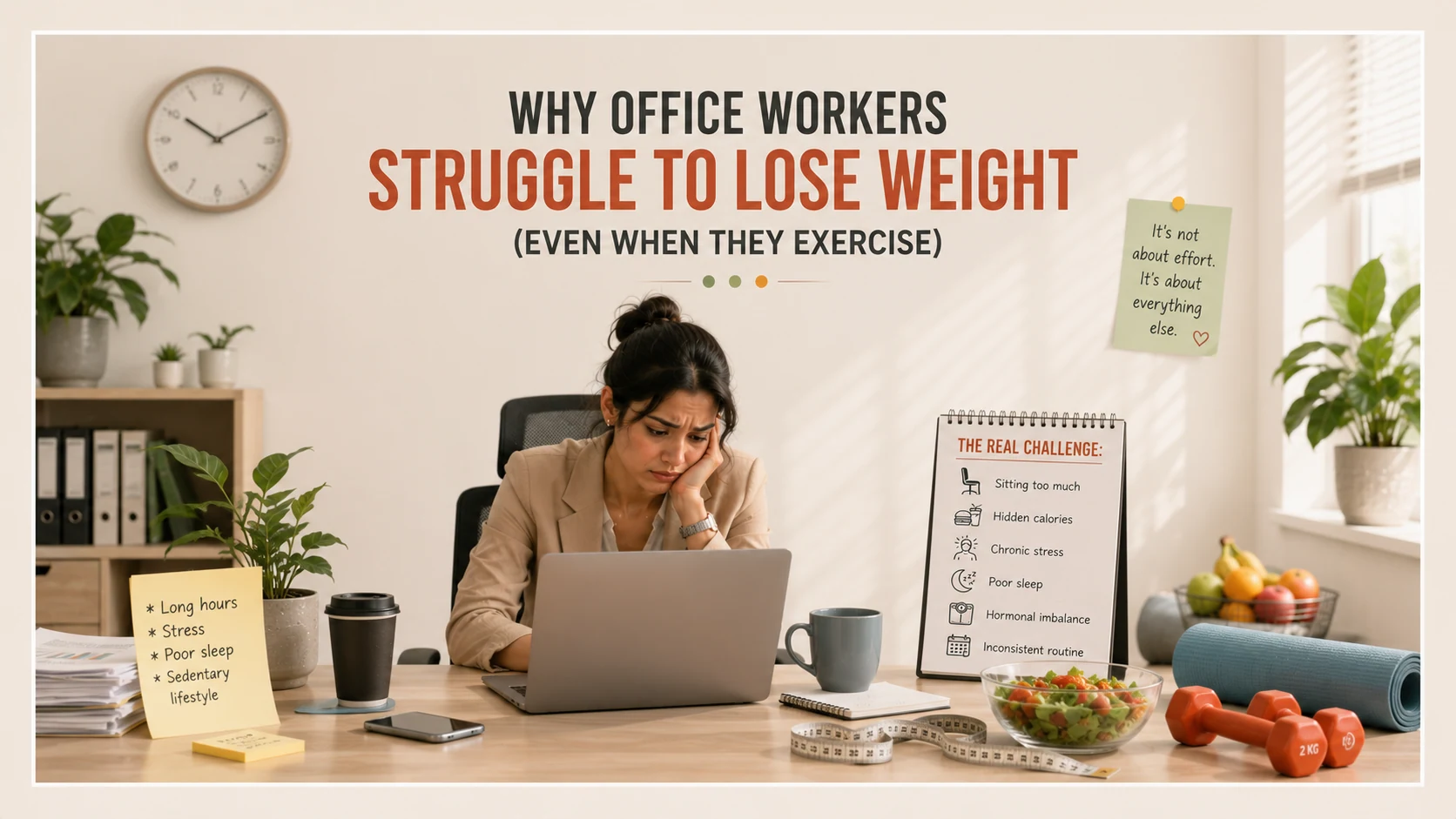
Why Office Workers Struggle to Lose Weight (Even When They Exercise)
Here is a frustrating scenario many office workers know well. You wake up early, get in a solid workout, eat reasonably well, and yet the scale barely moves week after week. Meanwhile, someone with what looks like a far less disciplined routine seems to lose weight without much effort.
This is not bad luck, and it is not because exercise "does not work" for you. There are specific, well-documented reasons why desk jobs make weight loss harder, even for people who are genuinely putting in effort at the gym. Understanding these reasons is the first step to actually fixing the problem.
The Core Problem: Exercise Is Not the Same as Total Daily Movement
This is the single biggest misunderstanding behind why office workers struggle to lose weight despite exercising.
Your body burns calories in a few different ways. One portion comes from your basic functions like breathing and digestion, called your basal metabolic rate. Another portion comes from digesting food. A smaller portion comes from structured exercise. But a surprisingly large portion, for many people the largest variable portion, comes from something called NEAT, or non-exercise activity thermogenesis.
NEAT includes all the movement you do outside of formal workouts, like walking around the house, fidgeting, taking the stairs, standing while talking, and general daily movement. For someone with an active lifestyle outside the gym, NEAT can account for a significant chunk of daily calorie burn. For someone who sits at a desk for 9 hours, commutes by car, and then relaxes on the sofa in the evening, NEAT can drop dramatically, even if they hit the gym for an hour every morning.
This is why two people who exercise the same amount can have very different results. The one with a more active overall lifestyle, even outside the gym, is burning meaningfully more calories across the day.
For more on this, read our article on how long sitting affects metabolic health.
Why a Morning Workout Does Not "Cancel Out" a Sedentary Day
This connects directly to a concept covered in our article on sitting all day: exercise and sedentary behaviour are now understood as two separate risk factors, not opposites that cancel each other out.
A 45-minute workout might burn 300 to 400 calories. But if the other 15 to 16 waking hours of the day involve almost no movement, the cumulative calorie burn from NEAT can be hundreds of calories lower than someone with a more active daily routine, even one who skips the gym entirely.
This is sometimes called the "compensation effect." Some research suggests that people who exercise intensely may unconsciously reduce their movement for the rest of the day, as if their body is compensating for the exertion, which can further shrink the gap between an active exerciser and a sedentary day.
Other Reasons Office Workers Struggle to Lose Weight
1. Stress and Cortisol
Desk jobs, particularly high-pressure ones, often come with chronic low-grade stress. Elevated cortisol over long periods is associated with increased fat storage, particularly around the abdomen, and can also increase cravings for high-calorie, high-sugar foods. Read more in Cortisol and Weight Loss.
2. Poor Sleep Quality
Long work hours, screen exposure late into the evening, and stress commonly disrupt sleep among office workers. Poor sleep is strongly linked to increased hunger hormones, reduced willpower around food choices, and lower energy for the next day's activity, creating a cycle that is hard to break. See Sleep and Hormones.
3. Mindless Eating at the Desk
Eating lunch while working, snacking absentmindedly during stressful moments, or grazing throughout the day without much awareness is extremely common in office settings. This often leads to underestimating actual calorie intake significantly.
4. Irregular Meal Timing
Back-to-back meetings frequently push lunch later, compress eating into rushed windows, or lead to skipped meals followed by overeating later. This irregular pattern can affect blood sugar control and increase the likelihood of overeating in the evening.
5. Social and Workplace Food Culture
Frequent team lunches, celebratory snacks, and the easy availability of canteen or delivery food in many Indian workplaces add up to extra calories that are easy to underestimate, especially when eaten in a social setting where portion awareness naturally drops.
Important: A single workout cannot fully compensate for 8 or more hours of daily sitting. Exercise and sedentary behaviour are separate risk factors, not opposites that cancel each other out.
Why Weight Loss Plateaus Happen Even With a Good Routine
Beyond NEAT and stress, there is another factor worth understanding honestly: the body adapts to whatever routine you give it. When someone starts a new exercise habit, the first few weeks often bring visible results, partly from genuine fat loss and partly from water weight changes and improved digestion. After this initial period, the body's metabolism adjusts somewhat to the new normal, a phenomenon sometimes called metabolic adaptation.
This does not mean progress stops permanently. It means that the same workout and diet that produced results in month one may need adjustment by month three, whether that is a change in workout intensity, a recalculation of calorie needs as body composition shifts, or simply more attention to the NEAT and lifestyle factors covered throughout this article. Office workers who expect linear, unchanging progress from a fixed routine often misread this normal plateau as their effort "not working," when really it is a sign that the plan needs to evolve alongside the body's adaptation.
This is one of the most overlooked reasons people abandon otherwise reasonable fitness routines. They are not failing. Their body has adapted, and the routine simply has not been adjusted to keep pace.
Related reading: the weight loss plateau.
A Realistic Comparison: Active Job vs. Desk Job
| Factor | Active Job (e.g. retail, field work) | Desk Job |
|---|---|---|
| Daily NEAT (movement outside exercise) | High | Low |
| Typical sitting hours per day | 2 to 4 hours | 8 to 11 hours |
| Impact of a single daily workout | Adds to an already active base | Has to compensate for a mostly sedentary day |
| Risk of mindless eating | Lower, due to more movement breaks | Higher, due to prolonged desk-bound focus |
| Weight loss difficulty | Generally easier with the same diet and exercise effort | Generally harder without addressing NEAT and stress |
This comparison is not about which job is "better." It simply explains, with real factors, why the same workout and similar diet can produce very different results depending on the overall activity context of someone's day.
What Actually Works for Weight Loss as an Office Worker
1. Increase NEAT Deliberately
Since NEAT often makes the biggest difference, deliberately rebuilding daily movement matters as much as, or more than, adding another workout. This includes standing calls, walking meetings, taking stairs, and short movement breaks, as covered in our desk workout guide.
2. Prioritise Protein and Fibre at Meals
Office meals, especially convenient ones, tend to be heavy in refined carbohydrates and low in protein and fibre. Both protein and fibre significantly improve fullness, which naturally reduces overeating later in the day without requiring strict calorie counting. See Protein Guide.
3. Address Sleep Before Adding More Exercise
If sleep is consistently under 6 hours, improving sleep often produces a bigger impact on weight loss than adding another workout to an already tired, under-recovered body.
4. Manage Stress Directly, Not Just Through Exercise
While exercise helps with stress, chronic high-pressure jobs often need additional stress management strategies, like short breathing breaks, boundaries around work hours, or simply protecting consistent sleep and meal timing, to meaningfully reduce cortisol-driven fat storage.
5. Track Eating Patterns Honestly for a Week
Many office workers genuinely underestimate their calorie intake from desk snacking, team lunches, and rushed meals. A simple honest week of tracking, even informally, often reveals patterns that explain a weight loss plateau better than the workout routine itself.
You may also like our guide on staying active with a desk job.
Common Mistakes Office Workers Make While Trying to Lose Weight
Point 1: Over-relying on exercise while ignoring NEAT. As covered above, this is the single biggest factor most weight loss plans for office workers miss. Point 2: Choosing extreme calorie restriction. This often backfires through increased cravings, lower energy, and binge patterns, especially difficult to sustain alongside a demanding job. Point 3: Skipping meals to "save calories." This frequently leads to overeating later and disrupts blood sugar stability throughout the day. Point 4: Ignoring stress and sleep entirely. As discussed, these two factors can outweigh exercise and diet efforts if left unaddressed. Point 5: Expecting fast results. Office job weight loss, given the additional NEAT and stress related barriers, often takes a more patient, layered approach rather than a quick fix.
How fitnoa Helps Office Workers Overcome This Specific Challenge
Understanding why weight loss is harder with a desk job is useful, but the real value comes from having a system that addresses the actual root causes, not just adding another workout to an already tired routine.
Personalised Nutrition and Diet Plans
fitnoa's personalised nutrition and diet plans are particularly relevant here, since, as explained above, eating patterns and meal timing often play a bigger role in office worker weight loss plateaus than exercise alone. Personalised guidance helps address mindless desk eating and irregular meal timing in a way generic diet advice usually cannot.
Goal-Based Weight Loss Program
The goal-based weight loss program combines structured live training with this nutrition support, directly addressing both sides of the equation covered throughout this article, rather than treating exercise as the only lever.
Detailed Fitness Reports
fitnoa's detailed fitness reports, which track calories burned, performance, and BMI after every session, also help build a clearer, more honest picture of progress over time, which is valuable given how easy it is for office workers to underestimate daily movement and overestimate the impact of a single workout.
Diabetes-Focused Program
For those whose desk job has contributed to additional concerns like early signs of poor blood sugar control, the diabetes-focused program offers structured support specifically designed around this connection between sedentary work and metabolic health.
Key Takeaways
- Office workers often struggle to lose weight not because exercise fails, but because non-exercise movement, or NEAT, drops dramatically with a desk job.
- A single workout cannot fully compensate for 8 or more hours of daily sitting.
- Stress, poor sleep, and mindless desk eating frequently play a bigger role in weight loss plateaus than the workout routine itself.
- Deliberately rebuilding daily movement and addressing meal timing often produces better results than adding more intense exercise.
- A combined approach, addressing movement, nutrition, sleep, and stress together, works better than focusing on exercise alone.
Related reads you may find helpful
Frequently asked questions
Everything you need to know
Fix the Real Reasons Weight Loss Has Stalled
Exercise alone often is not the missing piece. fitnoa combines live structured training with personalised nutrition support, so movement, meals, sleep, and stress finally work together instead of against each other.