
Pregnancy Workout Program: A Simple Weekly Plan for Every Trimester
A good pregnancy workout program gives you about 150 minutes of moderate activity a week, including two strength sessions, which is exactly what the NHS recommends. In practice that means brisk walks on most days, two or three short strength workouts, some mobility or prenatal yoga and daily pelvic floor exercises. Keep the effort at a level where you can still talk. The plan shifts a little each trimester: gentle and steady in the first, strongest in the second, and focused on mobility, breathing and labour preparation in the third.
A program helps because it takes the thinking out of each day. When you're tired, you don't have to decide what to do. You just do Tuesday's session. FitMama makes a similar point: following a structured plan is often safer than piecing together random workouts.
Important: Get your doctor's clearance before starting any workout program, and check again if anything changes in your pregnancy.
What does a weekly pregnancy workout program look like?
| Day | Session | Time |
|---|---|---|
| Monday | Strength, full body | 25 to 30 minutes |
| Tuesday | Brisk walk | 30 minutes |
| Wednesday | Prenatal yoga or mobility | 30 to 45 minutes |
| Thursday | Strength, full body | 25 to 30 minutes |
| Friday | Brisk walk or swim | 30 minutes |
| Saturday | Prenatal yoga or a longer walk | 30 to 45 minutes |
| Sunday | Rest |
Do pelvic floor squeezes every day. If you're new to exercise, the NHS suggests starting with about 10 minutes a day and building up slowly.
How should a strength session be structured?
FitMama's first-trimester plan uses a simple format that works through pregnancy:
- 30 seconds per exercise
- 2 to 3 rounds
- 30 to 60 seconds of rest between exercises
- Stop before tiredness starts to spoil your form
First trimester (weeks 1 to 12)
Many women feel sick and exhausted, so the goal is to keep moving without pushing.
- Cardio: walking at a comfortable pace, 20 to 30 minutes
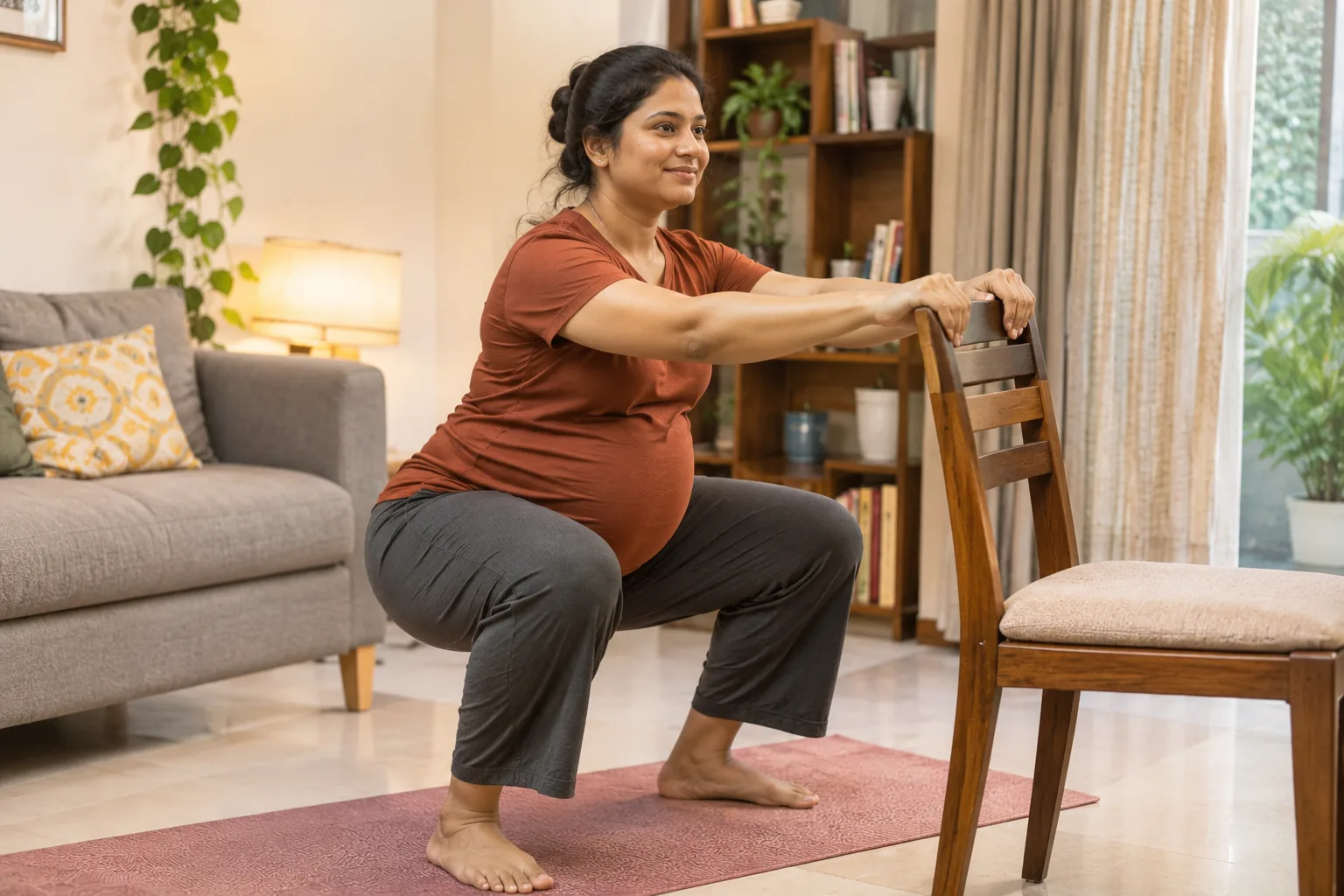
- Strength: glute bridges, bird-dog, squats to a chair, wall push-ups, side-lying leg lifts
- Mobility: cat-cow, hip circles, shoulder rolls
- On bad days: a 10-minute walk and a few stretches is plenty
Second trimester (weeks 13 to 27)
Energy usually returns, and this is the best time to build strength.
- Cardio: brisk walking, stationary cycling or swimming, 30 minutes
- Strength: chair squats, split squats holding a wall, hip thrusts, wall or chair push-ups, step-ups on the bottom stair near a railing, modified side plank
- Swap: move floor work off your back. The NHS advises not lying flat on your back for more than a few minutes in later pregnancy.
- Mobility: cat-cow, cobbler's pose, gentle thoracic rotations
Third trimester (weeks 28 to 40)
Balance changes and the bump gets in the way. Keep moving, gently.
- Cardio: walking or swimming, 20 to 30 minutes. The NHS notes that water takes pressure off your joints.
- Strength: lighter chair squats, wall push-ups, standing band rows, side-lying leg lifts, fewer rounds
- Labour prep: wall squats with a ball behind your back, pelvic tilts, hip circles on a birthing ball, breathing practice. Mayo Clinic explains that squatting in labour helps open the pelvis, so practising now makes it easier later.
- Rest more, and stop anything that causes pelvic pain
You may also like our guide: 7 Month Pregnancy Exercise for Normal Delivery
How hard should you work?
Use the talk test. You should be able to speak in full sentences while you exercise. The NHS describes moderate activity as raising your heart rate, making you breathe faster and feel warmer, while still being able to talk. If you can only get a few words out, slow down.
What to leave out of your program
- Lying flat on your back for long in later pregnancy
- Crunches, sit-ups and heavy twisting
- Jumping, sprinting and other high-impact moves
- Contact sports and anything with a risk of falling
- Heavy lifting and holding your breath
- Exercising on an empty stomach or in hot, humid conditions
Why a program works better with a coach
A written plan tells you what to do. It can't tell you whether you're doing it well. In pregnancy that matters, because loosened joints and a shifting centre of gravity make it easier to strain your knees, back or pelvis with small form mistakes.
Big structured programs exist online. The Sculpt Society's TSS Mama, for example, offers more than 200 prenatal classes with optional workouts for each of the 40 weeks. They're well made, but they're recorded.
fitnoa's live prenatal classes follow a trimester-wise plan like the one above, led by trained instructors. An AI watches every person's posture and alerts the instructor the moment someone needs a correction, so you get personal coaching in a group class without paying for a personal trainer. Private Mode keeps your video visible only to your coach.
Stop and call your doctor if you notice
- Vaginal bleeding or fluid leaking
- Regular, painful contractions
- Dizziness, feeling faint or chest pain
- Shortness of breath before you start
- Calf pain or swelling
- Muscle weakness that affects your balance
Related reads you may find helpful
Frequently asked questions
Everything you need to know
A Program That Watches Your Form
fitnoa's live prenatal workouts follow a trimester-wise plan. Our AI alerts your instructor whenever your posture needs fixing, so every set is safe. Personal coaching in every session. Book your free trial session.