
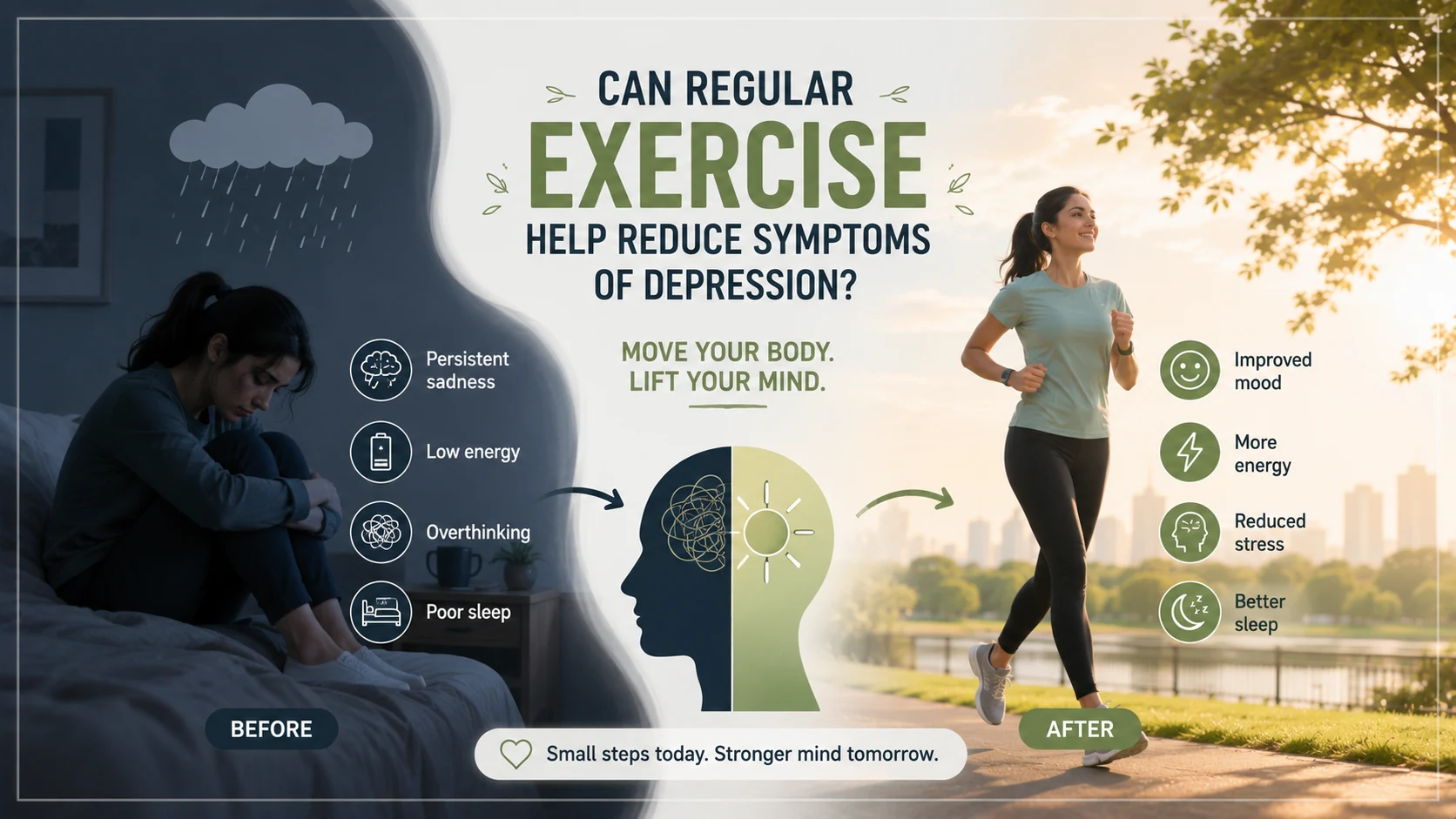
Can Regular Exercise Help Reduce Symptoms of Depression?
When you are depressed, the idea of exercising can feel almost laughable. The same low energy and motivation that depression causes are exactly what exercise seems to demand. So why do doctors and researchers keep recommending it?
The honest answer is that exercise is not a cure for depression, but the evidence behind its benefits is strong enough that it is now recommended as part of standard treatment guidelines in many countries, alongside therapy and medication, not instead of them.
This article explains what the research actually shows, how exercise affects a depressed brain biologically, how much movement is genuinely needed, and realistic ways to start when motivation itself is the thing depression has taken away.
What Depression Actually Does to the Brain and Body
Depression is not just sadness. It is a mental health condition that affects energy, motivation, sleep, appetite, concentration, and the ability to feel pleasure in things that used to feel enjoyable, a symptom doctors call anhedonia.
Biologically, depression is linked to lower activity of certain neurotransmitters, brain chemicals like serotonin, dopamine, and norepinephrine that regulate mood, motivation, and reward. It is also linked to higher levels of inflammation in the body and reduced activity in parts of the brain responsible for planning and motivation.
This matters because it explains why depression makes starting anything, including exercise, genuinely harder than it looks from the outside. It is not laziness. It is a measurable change in brain chemistry and function.
Does Exercise Actually Help With Depression? What Studies Show
Yes, multiple large scale reviews and clinical trials confirm that regular exercise reduces depressive symptoms. Some research has found that structured exercise programs can be as effective as antidepressant medication for mild to moderate depression, particularly when done consistently over 8 to 12 weeks.
This does not mean exercise should replace medication or therapy, especially for moderate to severe depression. Many mental health professionals now recommend combining exercise with these treatments rather than choosing one over the other, since each works through somewhat different mechanisms.
Important: Exercise supports treatment for depression, but it does not replace clinically recommended care. Always combine exercise with therapy or medication if these have been recommended for you.
How Exercise Changes a Depressed Brain
Several biological pathways explain why movement helps lift depressive symptoms.
It increases neurotransmitter activity. Exercise raises levels of serotonin, dopamine, and norepinephrine, the same chemical systems targeted by many antidepressant medications, but through a natural physiological process rather than a drug.
It reduces inflammation. Depression is associated with higher levels of inflammatory markers in the body. Regular physical activity has an anti-inflammatory effect over time, which may partly explain its mood benefits. Read more about best anti-inflammatory foods for joint pain and inflammation to support this from a nutrition angle too.
It promotes brain cell growth. Exercise increases a protein called BDNF (brain-derived neurotrophic factor), which supports the growth of new neurons and connections, particularly in the hippocampus, a brain region involved in mood regulation that tends to shrink in chronic depression.
It restores a sense of structure and achievement. Depression often strips away routine and a sense of accomplishment. Completing even a short workout provides a small, repeatable win, which can slowly counter the feelings of helplessness depression creates.
It improves sleep, which depression usually disrupts. Better sleep quality directly supports mood regulation, and the relationship works in both directions: poor sleep worsens depression, and exercise is one of the most effective ways to improve sleep naturally. Learn more in how sleep affects weight loss and hormones in women.
For more on this, read our article on exercise for anxiety.
How Much Exercise Is Needed to See Improvement?
The research is fairly consistent on quantities, even if it took years to firm up.
- Frequency: Most studies showing benefit used 3 to 5 sessions per week.
- Duration: Sessions of 30 to 45 minutes showed the clearest benefits, though shorter sessions still helped.
- Timeline: Noticeable improvement in mood typically appeared within 4 to 6 weeks of consistent activity, though some people report feeling better after just a few sessions.
- Intensity: Moderate intensity, activity that raises your heart rate but still allows conversation, was as effective as more vigorous exercise in most studies, and far more sustainable.
The key insight here is that you do not need to push to exhaustion. Depression already drains energy reserves, so a sustainable, moderate routine will serve you far better than an intense plan you cannot maintain.
For more on this, read our article on the mind-body connection.
Which Types of Exercise Help Most With Depression?
Walking Outdoors
Combines movement with natural light exposure, both linked to mood. Good for anyone, especially beginners with low energy.
Strength Training
Builds visible progress and a sense of accomplishment. Good for people struggling with low self-esteem or motivation. See weight training at home without injuries to get started safely.
Group Fitness or Team Sports
Adds social connection, which independently reduces depression. Good for people experiencing isolation.
Yoga
Combines gentle movement with breath control and mindfulness. Good for people with low energy or co-occurring anxiety. Try this morning yoga routine for beginners at home in india.
Dance or Rhythmic Cardio
Engages reward pathways through enjoyment and music. Good for people who find traditional workouts unmotivating.
Real life context helps here. Someone managing depression alongside a demanding job in a city like Mumbai or Bengaluru might find that a 20 minute walk during a lunch break, combined with natural daylight, is more sustainable than committing to an early morning gym session they keep skipping.
Common Mistakes When Using Exercise to Manage Depression
Point 1: Waiting to feel motivated before starting. Depression often removes motivation first, and the energy and motivation tend to return after action, not before it. Point 2: Setting goals that are too ambitious. A goal like "exercise every single day for an hour" is easy to fail and can reinforce feelings of inadequacy. Point 3: Exercising alone when isolation is already a problem. Solitary exercise alone may not address the social component of recovery. Point 4: Treating one good week as proof it is "working" or "not working." Mood naturally fluctuates, and judging progress week to week often leads to giving up too early. Point 5: Stopping medication or therapy because exercise feels helpful. Exercise supports treatment, it does not replace clinically recommended care.
If you have tried to build a routine before and struggled to stick with it, this article on why you're not seeing results from your workouts may offer useful troubleshooting.
Practical, Realistic Tips to Start When Motivation Is Low
- Lower the bar dramatically at first. Five minutes of movement is a legitimate starting goal. The aim is building consistency, not intensity.
- Pair exercise with something you already do. Walking while on a phone call, or stretching while watching something, reduces the activation energy needed to start.
- Choose a fixed, low effort time. Right after waking up or right after a specific daily task removes the need to decide "when" each day, which depression makes exhausting.
- Use guided sessions instead of planning your own. Following a trainer or structured class removes decision making, which is often the hardest part when motivation is low.
- Track effort, not outcome. Showing up counts as success, regardless of how hard you pushed that day.
- Tell someone you trust about your plan. Mild accountability, even just texting a friend that you went for a walk, can help on days willpower alone is not enough.
How fitnoa Supports Exercise as Part of Managing Depression
Depression makes the planning and decision making side of exercise especially difficult. fitnoa is designed to remove much of that friction so the only thing you need to do is show up.
Live fitness sessions with expert trainers: Rather than having to plan your own workout, a trainer guides you through the session in real time, which removes the mental load of deciding what to do.
Goal-based fitness programs, including general fitness plans: Structured programs give you a clear, manageable path forward instead of an overwhelming, open ended decision about what kind of exercise to do.
Detailed fitness reports after every session: Seeing concrete data, reps completed, calories burned, performance, gives visible proof of progress on days your mind may be telling you that nothing you do matters.
Privacy mode during group sessions: Depression often comes with self consciousness or low confidence about being seen. Since only the trainer and you are visible to each other, this removes a significant barrier to joining a class.
Personalised nutrition and diet plans: Diet and mood are closely connected, and having nutrition guidance alongside fitness support means your overall wellbeing is being addressed, not just one piece of it. See what to eat before and after workouts for better results to learn more.
If you would like expert support with this, take a look at fitnoa's yoga and holistic wellness program.
Key Takeaways
- Regular exercise measurably reduces depressive symptoms by increasing mood regulating brain chemicals, reducing inflammation, and supporting new brain cell growth.
- Studies suggest 3 to 5 sessions per week of moderate intensity exercise, for 30 to 45 minutes, with visible improvement typically within 4 to 6 weeks.
- Exercise works best as a complement to therapy and medication, not a replacement, especially for moderate to severe depression.
- Walking outdoors, strength training, and group activities each offer distinct benefits depending on your specific symptoms.
- Starting small and removing decision fatigue, rather than waiting for motivation, is the most realistic way to build a sustainable routine.
- Structured, guided platforms like fitnoa can lower the barrier to consistency by handling the planning and providing visible progress tracking.
Related reads you may find helpful
Frequently asked questions
Everything you need to know
Show Up, Even on the Hard Days
Depression can make even the simplest plan feel overwhelming, but fitnoa removes the guesswork with live, guided sessions and a privacy mode for when you'd rather not be seen. Take the smallest step forward today and let a trainer handle the rest.