
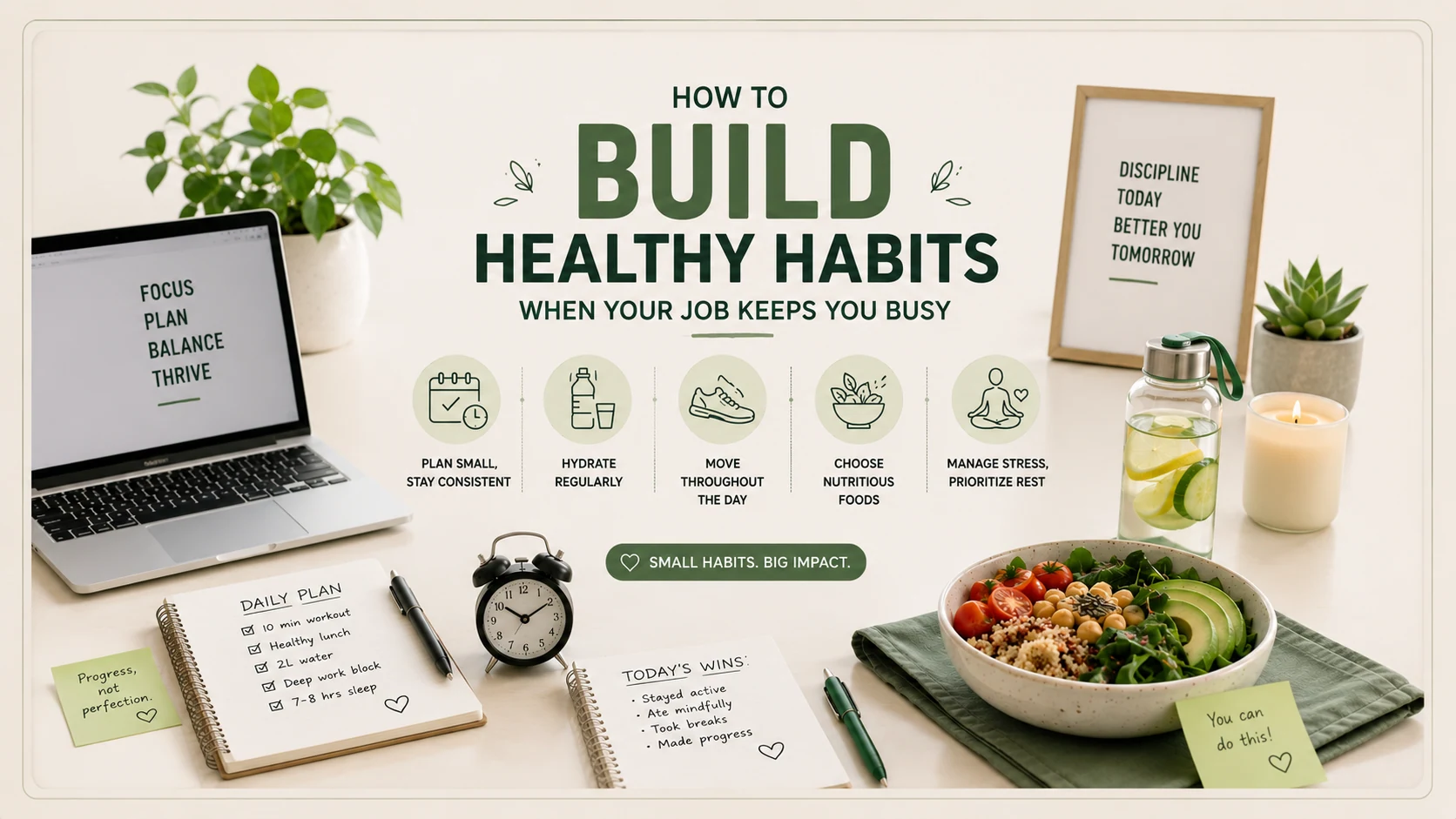
How to Build Healthy Habits When Your Job Keeps You Busy
"I will start once things calm down at work." If you have said this to yourself more than once, you already know the problem: for most working professionals, things rarely calm down. Deadlines shift, new projects appear, and the "right time" to start building healthy habits keeps moving further away.
The good news is that the busiest people are not actually doomed to poor health. They simply need a different approach to building habits than the one most fitness advice assumes, one that does not depend on having abundant free time or willpower.
This article breaks down exactly how to build genuinely sustainable healthy habits, even with a demanding job, using practical strategies rather than generic motivation.
Why Most Healthy Habit Advice Fails Busy Professionals
A lot of standard health advice assumes a baseline of free time, energy, and flexibility that simply does not match the reality of a demanding job. This mismatch is often the real reason habits fail, not personal failure or lack of discipline.
It assumes willpower is unlimited. In reality, willpower is a limited resource that gets depleted through the day, especially in mentally demanding jobs involving constant decisions and problem-solving.
It assumes consistent free time. Advice like "exercise for an hour every day" ignores the reality of unpredictable meeting schedules, travel, and shifting deadlines common in many jobs.
It treats one missed day as a failure. This all-or-nothing mindset is one of the biggest reasons people abandon habits entirely after a single disrupted week, even though one missed day has almost no real impact on long-term health.
Understanding these mismatches is the first step to building habits that actually survive contact with a busy, unpredictable schedule.
The Real Science of Habit Formation
Habits are formed through a repeated loop: a cue triggers a behaviour, which leads to a reward, and this loop strengthens the more it repeats in the same context. This is why habits tied to an existing routine, like brushing your teeth or making morning tea, tend to stick far more easily than habits requiring a brand new time slot and decision every day.
Research on habit formation generally suggests it takes anywhere from a few weeks to a couple of months for a new behaviour to start feeling automatic, depending on the complexity of the habit and how consistently it is repeated. This means the early weeks of any new healthy habit will feel effortful by design. This is normal, not a sign that something is wrong.
The Habit-Stacking Method for Busy Professionals
One of the most effective strategies for building healthy habits without needing extra time is called habit stacking: attaching a new small habit directly to an existing daily routine, rather than trying to create an entirely new time slot.
| Existing Habit | New Habit Stacked On Top |
|---|---|
| Brushing teeth in the morning | A 1-minute stretch right after |
| Making your morning tea or coffee | Drinking a full glass of water first |
| Commute (if by car or public transport) | A short podcast or audio focused on health education |
| Lunch break | A 10-minute walk immediately after eating |
| Brushing teeth at night | Reviewing one thing that went well with your health that day |
This method works particularly well for busy professionals because it does not ask for new time. It simply attaches a small action to something that already happens reliably every day, regardless of how busy work gets.
Related reading: a 10-minute morning yoga routine.
Start Smaller Than Feels Necessary
This might be the single most important principle for busy professionals trying to build lasting healthy habits, and it is counterintuitive to most fitness advice.
When time and energy are limited, starting with a goal that feels almost too easy, like a 5-minute walk instead of a 45-minute workout, dramatically increases the odds of actually doing it consistently. Once the habit itself becomes automatic, expanding it becomes far easier than trying to build consistency and intensity at the same time.
Many busy professionals fail not because they lack discipline, but because they start with a goal sized for an ideal week, not a realistic one, and then quit entirely the first time a hectic week makes that goal impossible.
You may also like our guide on a 5-minute desk workout.
Why Identity Matters More Than Motivation for Busy Professionals
Motivation is unreliable by nature. It fluctuates with sleep, stress, workload, and mood, all of which are especially volatile for someone juggling a demanding job. This is precisely why habits built purely on motivation tend to collapse during exactly the weeks when work pressure is highest, the weeks when consistency would matter most.
A more durable approach, supported by a lot of behavioural research, involves shifting the internal framing from "I am trying to exercise more" to "I am someone who moves daily, even briefly." This shift might sound like a small semantic difference, but it changes the decision-making process significantly. A person trying to exercise more is making a fresh, effortful decision every single day, often while mentally depleted from work. A person who identifies as someone who moves daily is simply acting in line with how they already see themselves, which requires considerably less willpower to sustain, especially during a demanding week.
This identity shift tends to happen naturally after a few weeks of consistent action, even small action, rather than needing to be forced from day one. This is part of why the earlier advice to start smaller than feels necessary matters so much: small, consistent wins build the identity faster than large, inconsistent efforts that frequently fail and reinforce a sense of "I am someone who struggles with this," instead.
Important: A single missed day has almost no real impact on long-term health. The actual risk is treating that missed day as a failure and abandoning the habit entirely.
A Realistic Framework for Building Healthy Habits With a Busy Job
Step 1: Choose One Habit, Not Five
Trying to overhaul diet, exercise, sleep, and stress management simultaneously rarely works, especially with limited time and energy. Choosing one specific habit to focus on for the first few weeks creates far better odds of success.
Step 2: Attach It to an Existing Routine
As covered above, habit stacking removes the need to find new time, which is usually the biggest barrier for busy professionals.
Step 3: Make the Habit Embarrassingly Easy at First
A 5-minute version of a habit that actually happens consistently is more valuable than an ambitious version that gets skipped most days.
Step 4: Track Consistency, Not Intensity
In the early weeks, the goal is showing up, not performing perfectly. Tracking whether you did the habit at all, even in its smallest form, matters more than tracking how well you did it.
Step 5: Expand Gradually Once It Feels Automatic
Once a small habit feels effortless, usually after a few weeks, gradually increasing its size or intensity tends to feel natural, rather than forced. See Strength Training for a natural next step once movement becomes routine.
You may also like our guide on staying active with a desk job.
How to Handle Travel, Deadlines, and Unpredictable Weeks
This is where most habit-building advice falls apart, because it rarely addresses what happens during the inevitable disruptive weeks that come with a demanding job.
Point 1: Define a "minimum viable habit." This is the smallest possible version of your habit that still counts, like a 2-minute stretch instead of a full workout, reserved specifically for your busiest, most disrupted days. Point 2: Protect the habit's frequency over its intensity during tough weeks. Doing a tiny version of the habit every day during a hectic week keeps the pattern alive, which matters more long-term than doing a full version a few times and then skipping entirely for a week. Point 3: Plan for travel in advance, not reactively. If you know a business trip is coming, deciding ahead of time what your minimum viable habit will look like during that week removes the need to figure it out under pressure. Point 4: Resume immediately after disruption, without a guilt-driven restart ritual. Simply resuming the very next available day works just as well and avoids the all-or-nothing trap covered earlier.
Common Mistakes Busy Professionals Make When Building Healthy Habits
- Waiting for the "right time" to start. As mentioned at the start of this article, for most demanding jobs, this moment rarely arrives on its own.
- Trying to build five habits at once. This spreads limited willpower and time too thin, often resulting in none of the habits sticking.
- Quitting after one missed day. A single missed day has minimal real impact. Treating it as a failure and abandoning the habit entirely is the actual problem.
- Choosing habits based on what worked for someone else's schedule. A habit that works for someone without a long commute or with more flexible hours may simply not fit a different job's realistic constraints.
- Ignoring the role of sleep in habit consistency. Poor sleep depletes the willpower needed to maintain any new habit, making sleep one of the most underrated foundations for successful habit building. See Sleep and Hormones for more.
Why Accountability Matters More for Busy Professionals
Busy schedules make it especially easy to quietly let a habit slide without really noticing, since there is always a legitimate-sounding reason: a late meeting, an urgent email, a tiring day. This is part of why purely self-directed habits, relying only on personal willpower and memory, often have a higher failure rate for busy professionals specifically.
External accountability, whether from a scheduled commitment, a coach, or a structured program with a clear routine, tends to perform significantly better for this group, since it removes the daily decision of whether to follow through, replacing it with a fixed, expected commitment.
How fitnoa Helps Busy Professionals Build Lasting Healthy Habits
Everything covered in this article points toward one central idea: habits succeed when they require less ongoing willpower and decision-making, and when there is some structure or accountability holding them in place.
Live Fitness Sessions
fitnoa's live fitness sessions function as exactly this kind of external structure. A scheduled session with a real trainer removes the daily decision of whether to exercise, replacing "should I work out today" with a fixed commitment already on your calendar, which, as explained above, is one of the most reliable ways busy professionals successfully build lasting habits.
Variety of Workout Formats
The variety of formats, including yoga, cardio, strength training, and bodyweight exercises, also makes it easier to apply the "start smaller" principle covered earlier, since shorter or gentler session types are available for the busiest, most depleted days, rather than an all-or-nothing single workout format.
Detailed Fitness Reports
fitnoa's detailed fitness reports after every session support the habit-tracking principle discussed in Step 4 above, giving busy professionals an easy, objective way to track consistency over time without needing to manually log anything themselves.
Personalised Nutrition Support
For those wanting to build broader healthy habits beyond exercise, fitnoa's personalised nutrition support extends this same structured, accountability-driven approach to eating habits, which, as covered in our article on office worker weight loss, often matters just as much as exercise consistency for overall health.
Learn how fitnoa's yoga and holistic wellness program can help.
Key Takeaways
- Most healthy habit advice fails busy professionals because it assumes abundant free time and unlimited willpower, neither of which matches the reality of a demanding job.
- Habit stacking, attaching new habits to existing routines, removes the need to find new time and significantly improves consistency.
- Starting smaller than feels necessary dramatically increases the odds of a habit actually sticking long-term.
- Defining a "minimum viable habit" for busy or disrupted weeks protects consistency without requiring perfection.
- External structure and accountability, like scheduled sessions with a real trainer, tend to outperform purely self-directed habit building for busy professionals.
Related reads you may find helpful
- How to Stay Active Even If You Work a 9-to-5 Desk Job
- Why Office Workers Struggle to Lose Weight (Even When They Exercise)
- Strength Training for Beginners at Home: Complete Guide (No Gym Needed)
- How Sleep Affects Weight Loss and Hormones in Women
- The 5-Minute Desk Workout You Can Do Without Leaving Your Chair
Frequently asked questions
Everything you need to know
Make Consistency Easier, Not Harder
Lasting habits need structure, not just willpower. fitnoa's scheduled live sessions give you a fixed commitment with real accountability, so showing up stops depending on how busy or tired you feel that day.